Sal's site
Maize Mexican Grill was named as a tribute to roots, family, and a geographic coincidence. Karina Sandoval chose the name to honor the upbringing of her husband, Armando. Born in Mexico City—the undisputed taco capital of the world—Armando also spent formative childhood years on his grandparents’ small farm. When the Sandovals later made Champaign-Urbana their home, Karina noticed a poetic parallel: the twin cities were bustling urban hubs surrounded by endless oceans of cornfields. The Mexican word for corn, maíz, felt like the perfect bridge between Armando’s past and their new home.
Karina’s clever branding didn’t stop there. She suggested adding the letter “e” to the end. Because maize is the scientific term for the crop, she reasoned that the inhabitants of their new college town would appreciate the academic nod.
“She’s the smart one,” Armando says with a warm laugh.
Armando loves to talk, his storytelling as rich as the food he serves. Sitting down with me, he breaks the ice with a memory from 2011, just two weeks after Maize first opened its doors. Near closing time on a Friday night, a well-known C-U writer approached the couple. Armando braced for a complaint, but instead, the writer launched into a passionate, slightly tipsy rave about how incredible the tacos were. An article followed shortly after, and within forty-eight hours, the tiny restaurant was completely swamped with eager customers.
Today, Armando and I sit at a two-person copper table in their downtown Champaign location, having the dining room to ourselves as the early evening light streams through large colonial windows. The historic space breathes tradition; Armando notes that the flooring hasn’t changed since the building’s days as a bustling train station. In addition to this downtown anchor, Maize feeds the campus community at the Illini Union—a bustling spot that Armando says reminds him of the charm of Maize’s original, now-demolished first building.

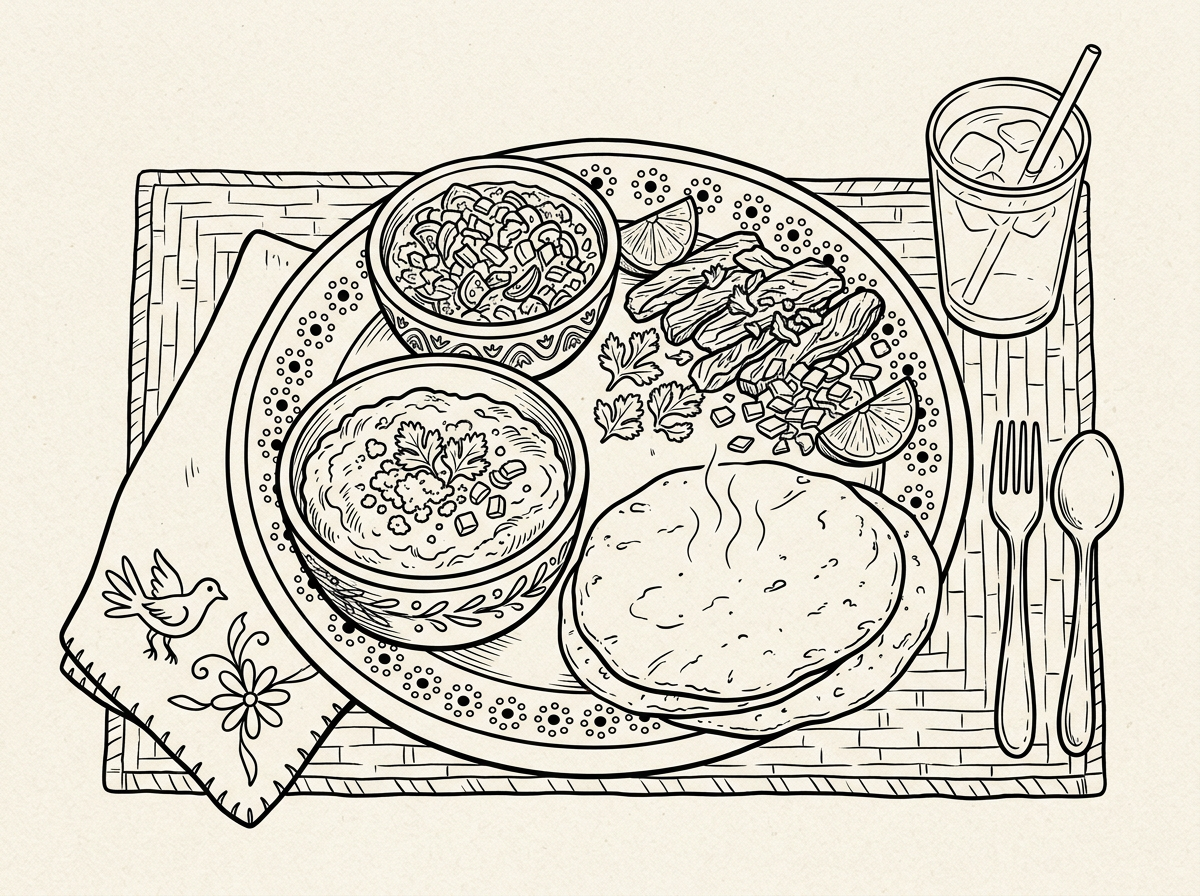
At its core, Maize Mexican Grill thrives on authenticity, serving scratch-made dishes anchored by fresh ingredients. According to Armando, the true secret weapon is the tortilla.
“If you ask for a quesadilla, there’s a lady in the back pressing the tortilla at that exact moment,” he says. “I think that’s a big part of the magic.”
That dedication to authentic Mexican culinary heritage extends to ingredients that might surprise the average midwestern palate, like huitlacoche—often colloquially referred to as “corn smut.” While Armando admits it isn’t his personal favorite, it is a massive hit with local vegetarians. He explains the biology of the delicacy: when young corn is nicked by wind or hail, rainwater seeps in, causing a rich, earthy mushroom to grow directly from the kernel. It yields a complex, peculiar taste prized by culinary adventurers.
Local farmers have embraced this cultural exchange, too. When the growing season starts, area growers now call Armando the moment they spot huitlacoche in their fields. Armando recalls cooking the delicacy for a local farmer in his sixties, who tried it, loved it, and immediately lamented all the corn smut he had thrown away over the years instead of bringing it to Maize.
“I think that’s the real magic in food,” Armando smiles.
For Armando, who studied sociology at the University of Illinois and originally planned to be a teacher, food should also be an expression of joy and humor. Take the huevos divorciados (divorced eggs) served during their popular weekend brunch. The dish plays out like a culinary drama: the two eggs are structurally separated, one cradled in a white corn tortilla and the other in a blue corn tortilla. One is bathed in vibrant green salsa, the other in fiery red, divided by a strict border of refried beans down the center.
“Those beans are really divorced,” Armando jokes. “They’re not getting back together.”
Armando splits his demanding days between the energetic campus rush at the Illini Union and the warmer, steady pace of the downtown location in the evening. It is a grueling schedule, but the rewards go far beyond the kitchen. Watching former student workers and long-time customers grow up, build careers, and achieve their dreams is Armando’s favorite part of the job.
“The restaurant business is a really hard business,” he reflects quietly. “A really, really hard business. But the human part of it—whether it’s the employees or the customers—that’s what makes it worth it. For me, at least.”
Photos by Sal Nudo.
This piece and 50 more on restaurants in Champaign-Urbana are available to read about in Eat Like a Local – Champaign-Urbana, published by CZYK Publishing.