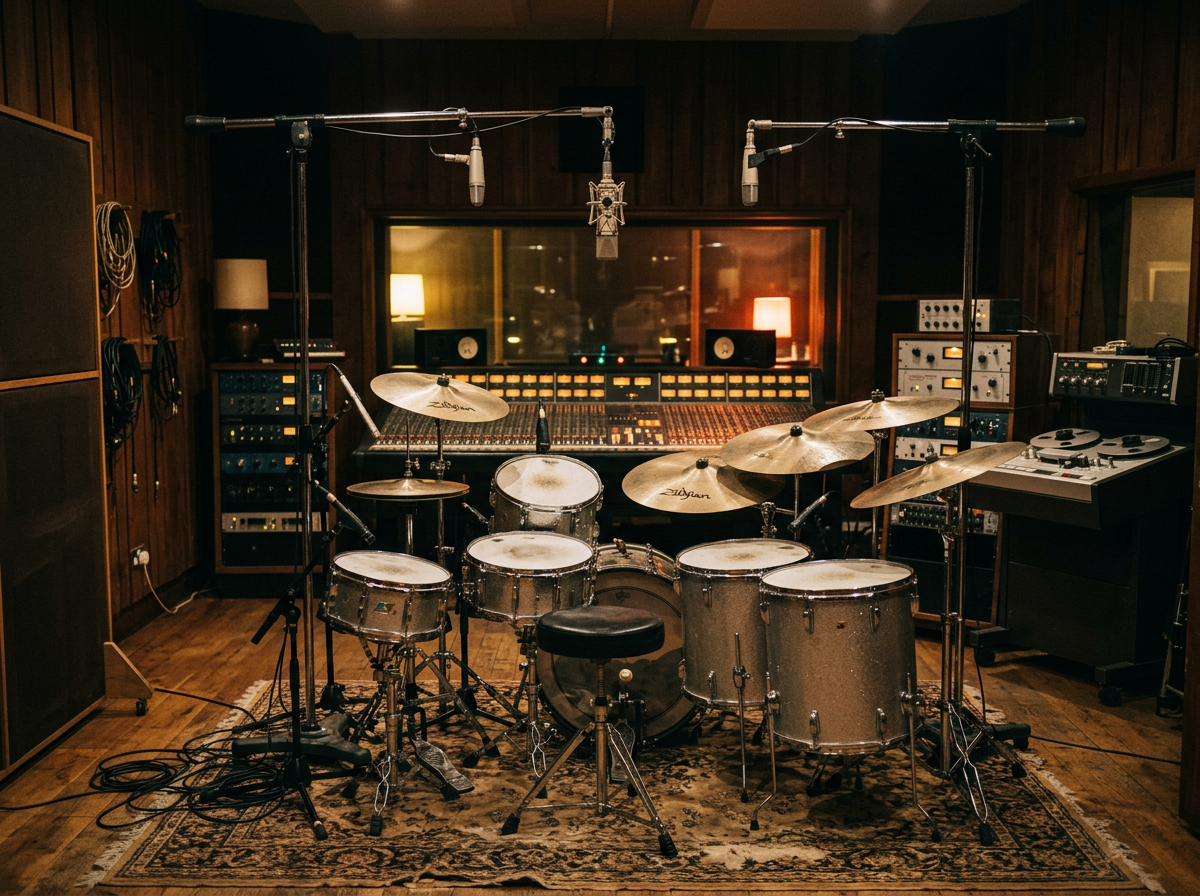
In the summer of 1979, inside Studio 2 at London’s Townhouse Studios, Peter Gabriel was trying to break his own habits. He was recording his third solo album—the famously eerie, shadowy record later nicknamed Melt—and he arrived with a strict rule for his rhythm section: no cymbals allowed.
Gabriel was tired of the wash and shimmer that cluttered late-1970s rock records. He wanted space, tension, and primal rhythm. Behind the drum kit sat his former Genesis bandmate, Phil Collins, stripped of his hi-hats, rides, and crashes, left with little more than a kick, a snare, and a row of toms. At the mixing console sat producer Steve Lillywhite and a young, sharp-eared engineer named Hugh Padgham.
At some point during the tracking sessions for a menacing, minimalist track called “Intruder,” Padgham made a routine mistake. He forgot to turn off the talkback microphone—a cheap, heavily compressed ambient mic hanging from the ceiling of the live room, designed solely so the musicians could speak to the engineers behind the glass. When Collins began pounding out a sparse, heavy beat on the snare and toms, the talkback mic picked up the thunderous echo of the stone-walled room, crushed it through a built-in compressor, and blasted it straight through the control room monitors.
Lillywhite and Padgham froze. Instead of hitting the mute button, they stared at the console. That accidental collision of room acoustics, extreme compression, and an electronic noise gate didn’t just rescue the session—it detonated a sonic Big Bang. Within twenty-four months, that sound would swallow pop, new wave, and arena rock whole.
What Is Gated Reverb, Actually?
To understand why that moment in London changed the trajectory of popular music, you have to understand what drums sounded like before 1980—and why engineers spent the previous decade trying to tame them.
Throughout the 1970s, the prevailing studio aesthetic favored dry, dead, tightly controlled drums. Producers draped tea towels over snare heads, taped wallets to drum skins, and stuffed pillows inside bass drums. Think of Fleetwood Mac’s Rumours or the Eagles’ Hotel California: the drums are crisp, intimate, and tucked neatly into the pocket. If you put a microphone in a big, reflective stone room to capture natural echo—what engineers call reverb—the sound waves bounced off the walls and lingered for seconds. On a fast rock song, all that lingering tail turned the mix into an indistinct wash of mud.
Gated reverb solved that problem by breaking the laws of natural acoustics.
The trick pairs two pieces of studio gear: a massive room sound (either captured by distant microphones in a live stone room or generated by a digital reverb unit) and a noise gate. A noise gate acts like an ultra-fast electronic bouncer standing at the door of an audio channel. When a loud sound—like a snare hit—arrives, the bouncer throws the door wide open, letting the entire explosive roar of the room rush through. The split second the volume drops below a preset threshold, the bouncer slams the door shut.
The result is completely unnatural and utterly intoxicating. You get the colossal, stadium-sized boom of a cannon firing inside an empty airplane hangar, followed immediately by dead, vacuum-sealed silence. There is no trailing echo to clutter up the guitars or vocals. Every hit lands with maximum physical impact and then vanishes before the next beat arrives.
From “Intruder” to “In the Air Tonight”
When Peter Gabriel’s third solo album arrived in May 1980, “Intruder” sounded like nothing else on the radio. Without cymbals to carry the high end, Collins’s gated snare hits cracked like whip snaps in a dark hallway. Musicians and producers across London immediately began calling Townhouse Studios to ask how Lillywhite and Padgham had pulled it off.
Before anyone else could fully reverse-engineer the trick, Phil Collins took it into his own solo sessions.
In January 1981, Collins released “In the Air Tonight.” For the first three minutes and forty seconds, the track simmers over a brooding synthesizer drone and a ticking Roland CR-78 drum machine. Tension builds layer by layer until the vocals drop out, the synth swells, and Collins unleashes the most famous three-second drum fill in rock history.
Boom-boom, boom-boom, boom-boom, boom-boom, boom-boom, BASH.
Hugh Padgham was behind the board again, routing Collins’s live kit through the Solid State Logic (SSL) console’s built-in talkback compressor and noise gates. Because the gate chopped off the reverb tail between every single tom hit, you didn’t just hear the drums—you felt the air pressure in the room compress and release. Radio programmers didn’t know what to make of a slow-burn ballad with no chorus until the fourth minute, yet listeners were hypnotized. Every car stereo in America suddenly became an audition booth for that single drum entrance.
How the Sound Conquered Arena Rock and Pop
Once “In the Air Tonight” went global, gated reverb stopped being an avant-garde studio experiment and became an industry requirement. If your snare drum didn’t sound like a falling redwood tree, your record sounded small—and in the 1980s, small was fatal.
The decade belonged to FM rock radio, massive arena tours, and the launch of MTV in August 1981. Music had become a widescreen visual medium, and producers needed drum tracks big enough to fill a 20,000-seat hockey arena. Gated reverb was the ultimate steroid for rhythm sections, and engineers pushed it into every corner of the dial:
- Hard Rock and Arena Metal: Nobody utilized the ’80s drum sound with greater precision than producer Robert John “Mutt” Lange. On Def Leppard’s Pyromania (1983) and Hysteria (1987), Lange took the spatial punch of gated reverb and fused it with obsessive layering, triggering, and sample reinforcement. Every snare crack on “Photograph” or “Pour Some Sugar on Me” hit with identical, superhuman velocity—designed specifically to punch through walls of multi-tracked guitars and soar to the back row of a stadium.
- Heartland Rock: When Bruce Springsteen recorded Born in the U.S.A. (1984), engineer Bob Clearmountain gave Max Weinberg’s snare a massive, booming gated treatment. The opening snare hits of the title track didn’t just set a tempo; they sounded like industrial machinery pounding steel.
- Pop and New Wave: From David Bowie’s Let’s Dance (engineered by Clearmountain) and Duran Duran’s Rio to Tears for Fears’ Songs from the Big Chair and Power Station’s thunderous cover of “Some Like It Hot,” gated percussion became the common language connecting synth-pop, dance clubs, and mainstream rock. Even when producers switched from acoustic rooms to early digital units like the AMS RMX16—which famously included a dedicated “NonLin2” preset modeled directly on Padgham’s Townhouse setup—the aesthetic remained the same: bigger, louder, sharper.
By 1987, the technique had become so ubiquitous that it was practically mandatory. You could drop the needle on almost any major-label release—whether heavy metal, adult contemporary, or country crossover—and hear that unmistakable burst-and-cutoff signature.
The Hangover—And Why We Still Miss That Scale
Every dominant sonic revolution eventually collapses under its own excess, and by the turn of the decade, listeners were suffering from gated-reverb fatigue. When every ballad and every rock single featured the exact same cavernous snare crack, the sound lost its element of surprise. What had begun as a subversive, claustrophobic accident on a Peter Gabriel record had morphed into corporate sheen.
In September 1991, Nirvana’s Nevermind—engineered by Butch Vig and mixed by Andy Wallace—hit the airwaves and effectively ended the era overnight. While Nevermind was far more polished than indie purists liked to admit, its drums were punchy, organic, and grounded in physical space rather than artificial electronic gates. By the time Steve Albini recorded Nirvana’s In Utero in 1993 using dozens of natural ambient room microphones with zero artificial gating, the 1980s drum sound had been officially banished to the nostalgia bin.
Yet more than four decades after Hugh Padgham left that talkback mic open in London, there is something oddly thrilling about going back and listening to those records at high volume.
Modern rock production is undeniably cleaner, tighter, and more technically consistent than anything recorded on analog tape in 1983. With digital editing, sample replacement, and grid-aligned perfection, any bedroom producer with a laptop can make a snare drum punch through a dense mix. But in gaining total control, modern production often sacrifices physical danger. Too many contemporary rock drums sound tidy, predictable, and weightless—polite transients sitting neatly inside a frequency slot.
When you cue up “Intruder,” “In the Air Tonight,” or the opening bars of Pyromania, you don’t hear polite digital efficiency. You hear engineers pushing analog consoles into the red, testing the limits of stone walls, and chasing a sound nobody had ever heard before. Gated reverb eventually ate the 1980s because everyone copied it—but the original hunger behind it, that urge to make a single drum hit feel larger than life itself, is something rock music could still use a healthy dose of today.
Love digging into the studio secrets behind classic rock?
Check out my book, 50 Studio Secrets That Defined 1980s Hard Rock, where I break down the gear, happy accidents, and obsessive production tricks behind the decade’s biggest records. Grab your copy on Amazon → https://www.amazon.com/dp/B0HM6QZH23/