Podcast Episode: The Machines, the Rooms, and the Riffs: Unveiling the ‘Behind the Glass’ Trilogy
Pip: If you’ve ever wondered what a recording studio smells like at two in the morning, Sal Nudo has spent the last year finding out — and apparently taking notes.
Mara: This episode covers the full rollout of the Behind the Glass book trilogy — three volumes on the craft, physics, and personalities behind the studio glass, spanning the 1980s hard rock era through the 1990s indie underground and into the anatomy of rock’s greatest guitar hooks.
Pip: Let’s get into the books.
The Machines, the Rooms, and the Riffs
Pip: The post frames this as a three-phase rollout — three books, three distinct eras of rock recording — and the central question is what actually happened behind the glass before digital safety nets existed.
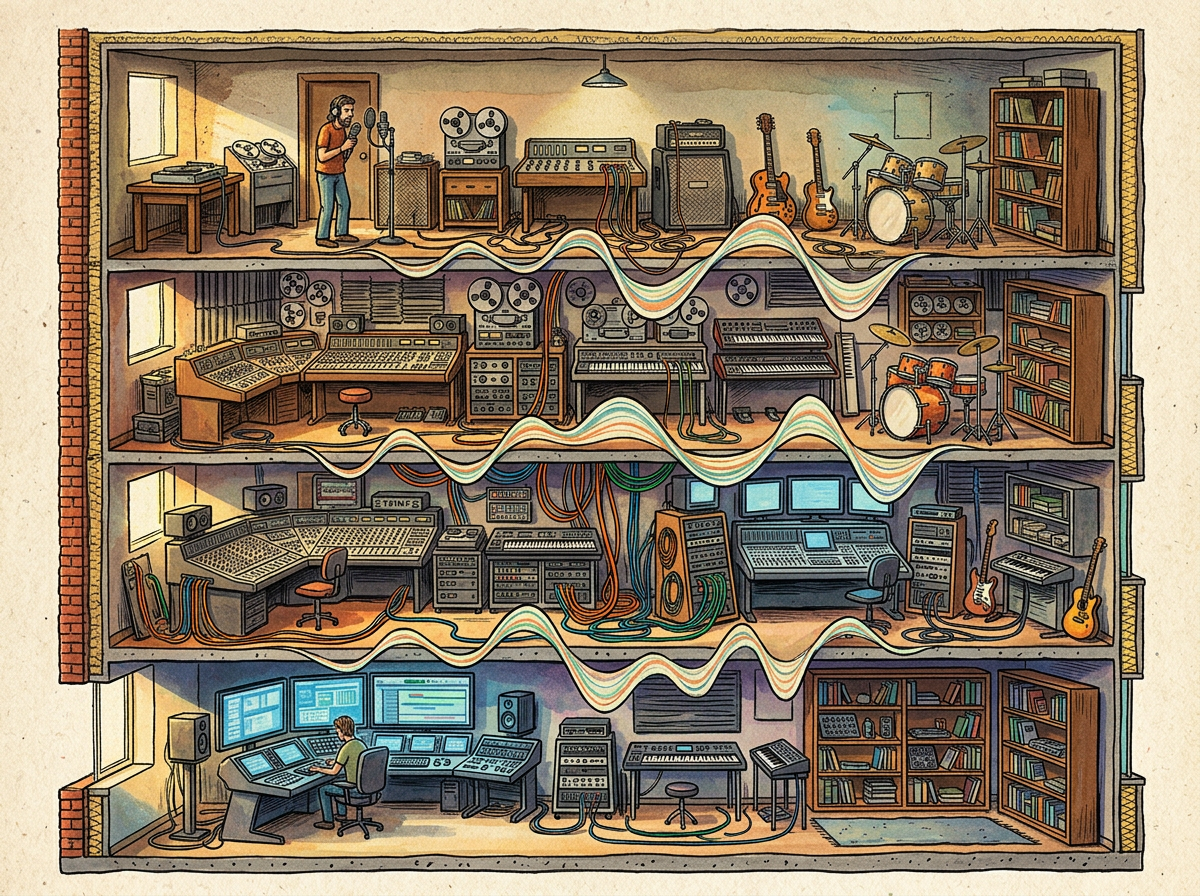
Mara: The Book 2 excerpt sets the scene directly. Here it is: “The tracking space smelled of damp floorboards, stale filter coffee, and heated vacuum tubes. Long before digital workstations offered infinite virtual undo buttons and surgical frequency notches, capturing an uncompromising rock band was an exercise in acoustic collision. You didn’t isolate the players into pristine, sterile dead zones; you put four musicians in an unvarnished room, set the levels on an analog console until the needle danced just below the red, and let the air itself do the heavy lifting.”
Pip: So the argument is that the imperfections weren’t bugs — the rattle, the squeak, the tape running hot — those were the record. The room was doing as much work as the musicians.
Mara: That’s exactly the framing. Book 1, arriving November 10 as a paperback, covers fifty studio milestones from the 1980s — the era of SSL consoles, gated reverbs, and producers who treated the recording console as an instrument in its own right. The focus is on how enormous ambition and studio budgets produced that signature high-gloss arena sound.
Pip: Which makes Book 2 the deliberate counter-argument — drafty church halls and zero-budget tape havens instead of million-dollar rooms.
Mara: Right. Book 2 launches November 24, and pre-orders are already live. It covers the 1990s indie-alternative underground: two-inch tape with no pitch correction, Pacific Northwest garage recordings, bedroom four-track experiments, shoegaze textures. Every section also includes custom black-and-white ink illustrations of the actual gear and tracking floors.
Pip: Hand-drawn diagrams of the consoles that built Nevermind — that’s either deeply nerdy or exactly what the genre deserves. Possibly both.
Mara: Book 3 closes out the trilogy in late December. Titled 50 Masterclass Riffs, it moves from room physics into the mechanical engines of the songs themselves — amplifier circuits, pickup choices, picking attacks, and the studio accidents behind fifty of rock’s most recognizable guitar hooks.
Pip: From the room to the riff — which is a pretty clean arc for a trilogy.
Mara: Three books, two decades of recording history, and one argument running through all of it: the physical act of pushing air through a room is where the music actually lives.
Pip: Next time, we’ll see what else is coming down the line. Don’t touch that dial — or whatever the podcast equivalent is.
Sal Nudo is the author of several fiction and nonfiction books available on Amazon. Drawing on his master’s degree in journalism from the University of Illinois Urbana-Champaign, his work often explores journalism techniques and creative nonfiction.
Nudo earned the “What I Believe” Essay Award from Townsend Press in 2025 and was a winner in the 2026 “One Room One Challenge” contest for his essay, “Intermittent Light.” He also received the Marian and Barney Brody Creative Feature Article Writing Award in 2015. His writing has been featured in Illinois Alumni magazine, the Mahomet Citizen, and in local publications.
{"id":null,"mode":"button","open_style":"in_modal","currency_code":"USD","currency_symbol":"$","currency_type":"decimal","blank_flag_url":"https:\/\/salnudo.com\/wp-content\/plugins\/tip-jar-wp\/\/assets\/images\/flags\/blank.gif","flag_sprite_url":"https:\/\/salnudo.com\/wp-content\/plugins\/tip-jar-wp\/\/assets\/images\/flags\/flags.png","default_amount":300,"top_media_type":"featured_image","featured_image_url":"https:\/\/salnudo.com\/wp-content\/uploads\/2023\/12\/pexels-suzy-hazelwood-3886870-200x120.jpg","featured_embed":"","header_media":null,"file_download_attachment_data":null,"recurring_options_enabled":true,"recurring_options":{"never":{"selected":true,"after_output":"One time only"},"weekly":{"selected":false,"after_output":"Every week"},"monthly":{"selected":false,"after_output":"Every month"},"yearly":{"selected":false,"after_output":"Every year"}},"strings":{"current_user_email":"","current_user_name":"","link_text":"If you enjoy my podcasts, please leave a tip!","complete_payment_button_error_text":"Check info and try again","payment_verb":"Pay","payment_request_label":"Sal's site","form_has_an_error":"Please check and fix the errors above","general_server_error":"Something isn't working right at the moment. Please try again.","form_title":"Sal's Site","form_subtitle":"Thanks for being a part of and supporting my work!","currency_search_text":"Country or Currency here","other_payment_option":"Other payment option","manage_payments_button_text":"Manage your payments","thank_you_message":"Thank you for supporting the work! Every tip fuels the next story (and the next cup of coffee). Truly appreciated!","payment_confirmation_title":"Sal's site","receipt_title":"Your Receipt","print_receipt":"Print Receipt","email_receipt":"Email Receipt","email_receipt_sending":"Sending receipt...","email_receipt_success":"Email receipt successfully sent","email_receipt_failed":"Email receipt failed to send. Please try again.","receipt_payee":"Paid to","receipt_statement_descriptor":"This will show up on your statement as","receipt_date":"Date","receipt_transaction_id":"Transaction ID","receipt_transaction_amount":"Amount","refund_payer":"Refund from","login":"Log in to manage your payments","manage_payments":"Manage Payments","transactions_title":"Your Transactions","transaction_title":"Transaction Receipt","transaction_period":"Plan Period","arrangements_title":"Your Plans","arrangement_title":"Manage Plan","arrangement_details":"Plan Details","arrangement_id_title":"Plan ID","arrangement_payment_method_title":"Payment Method","arrangement_amount_title":"Plan Amount","arrangement_renewal_title":"Next renewal date","arrangement_action_cancel":"Cancel Plan","arrangement_action_cant_cancel":"Cancelling is currently not available.","arrangement_action_cancel_double":"Are you sure you'd like to cancel?","arrangement_cancelling":"Cancelling Plan...","arrangement_cancelled":"Plan Cancelled","arrangement_failed_to_cancel":"Failed to cancel plan","back_to_plans":"\u2190 Back to Plans","update_payment_method_verb":"Update","sca_auth_description":"Your have a pending renewal payment which requires authorization.","sca_auth_verb":"Authorize renewal payment","sca_authing_verb":"Authorizing payment","sca_authed_verb":"Payment successfully authorized!","sca_auth_failed":"Unable to authorize! Please try again.","login_button_text":"Log in","login_form_has_an_error":"Please check and fix the errors above","uppercase_search":"Search","lowercase_search":"search","uppercase_page":"Page","lowercase_page":"page","uppercase_items":"Items","lowercase_items":"items","uppercase_per":"Per","lowercase_per":"per","uppercase_of":"Of","lowercase_of":"of","back":"Back to plans","zip_code_placeholder":"Zip\/Postal Code","download_file_button_text":"Download File","input_field_instructions":{"tip_amount":{"placeholder_text":"How much would you like to tip?","initial":{"instruction_type":"normal","instruction_message":"How much would you like to tip? Choose any currency."},"empty":{"instruction_type":"error","instruction_message":"How much would you like to tip? Choose any currency."},"invalid_curency":{"instruction_type":"error","instruction_message":"Please choose a valid currency."}},"recurring":{"placeholder_text":"Recurring","initial":{"instruction_type":"normal","instruction_message":"How often would you like to give this?"},"success":{"instruction_type":"success","instruction_message":"How often would you like to give this?"},"empty":{"instruction_type":"error","instruction_message":"How often would you like to give this?"}},"name":{"placeholder_text":"Name on Credit Card","initial":{"instruction_type":"normal","instruction_message":"Enter the name on your card."},"success":{"instruction_type":"success","instruction_message":"Enter the name on your card."},"empty":{"instruction_type":"error","instruction_message":"Please enter the name on your card."}},"privacy_policy":{"terms_title":"Terms and conditions","terms_body":"By submitting, you acknowledge that this tip is a voluntary, non-refundable personal gift and is not tax-deductible.","terms_show_text":"View Terms","terms_hide_text":"Hide Terms","initial":{"instruction_type":"normal","instruction_message":"I agree to the terms."},"unchecked":{"instruction_type":"error","instruction_message":"Please agree to the terms."},"checked":{"instruction_type":"success","instruction_message":"I agree to the terms."}},"email":{"placeholder_text":"Your email address","initial":{"instruction_type":"normal","instruction_message":"Enter your email address"},"success":{"instruction_type":"success","instruction_message":"Enter your email address"},"blank":{"instruction_type":"error","instruction_message":"Enter your email address"},"not_an_email_address":{"instruction_type":"error","instruction_message":"Make sure you have entered a valid email address"}},"note_with_tip":{"placeholder_text":"Your note here...","initial":{"instruction_type":"normal","instruction_message":"Attach a note to your tip (optional)"},"empty":{"instruction_type":"normal","instruction_message":"Attach a note to your tip (optional)"},"not_empty_initial":{"instruction_type":"normal","instruction_message":"Attach a note to your tip (optional)"},"saving":{"instruction_type":"normal","instruction_message":"Saving note..."},"success":{"instruction_type":"success","instruction_message":"Note successfully saved!"},"error":{"instruction_type":"error","instruction_message":"Unable to save note note at this time. Please try again."}},"email_for_login_code":{"placeholder_text":"Your email address","initial":{"instruction_type":"normal","instruction_message":"Enter your email to log in."},"success":{"instruction_type":"success","instruction_message":"Enter your email to log in."},"blank":{"instruction_type":"error","instruction_message":"Enter your email to log in."},"empty":{"instruction_type":"error","instruction_message":"Enter your email to log in."}},"login_code":{"initial":{"instruction_type":"normal","instruction_message":"Check your email and enter the login code."},"success":{"instruction_type":"success","instruction_message":"Check your email and enter the login code."},"blank":{"instruction_type":"error","instruction_message":"Check your email and enter the login code."},"empty":{"instruction_type":"error","instruction_message":"Check your email and enter the login code."}},"stripe_all_in_one":{"initial":{"instruction_type":"normal","instruction_message":"Enter your credit card details here."},"empty":{"instruction_type":"error","instruction_message":"Enter your credit card details here."},"success":{"instruction_type":"normal","instruction_message":"Enter your credit card details here."},"invalid_number":{"instruction_type":"error","instruction_message":"The card number is not a valid credit card number."},"invalid_expiry_month":{"instruction_type":"error","instruction_message":"The card's expiration month is invalid."},"invalid_expiry_year":{"instruction_type":"error","instruction_message":"The card's expiration year is invalid."},"invalid_cvc":{"instruction_type":"error","instruction_message":"The card's security code is invalid."},"incorrect_number":{"instruction_type":"error","instruction_message":"The card number is incorrect."},"incomplete_number":{"instruction_type":"error","instruction_message":"The card number is incomplete."},"incomplete_cvc":{"instruction_type":"error","instruction_message":"The card's security code is incomplete."},"incomplete_expiry":{"instruction_type":"error","instruction_message":"The card's expiration date is incomplete."},"incomplete_zip":{"instruction_type":"error","instruction_message":"The card's zip code is incomplete."},"expired_card":{"instruction_type":"error","instruction_message":"The card has expired."},"incorrect_cvc":{"instruction_type":"error","instruction_message":"The card's security code is incorrect."},"incorrect_zip":{"instruction_type":"error","instruction_message":"The card's zip code failed validation."},"invalid_expiry_year_past":{"instruction_type":"error","instruction_message":"The card's expiration year is in the past"},"card_declined":{"instruction_type":"error","instruction_message":"The card was declined."},"missing":{"instruction_type":"error","instruction_message":"There is no card on a customer that is being charged."},"processing_error":{"instruction_type":"error","instruction_message":"An error occurred while processing the card."},"invalid_request_error":{"instruction_type":"error","instruction_message":"Unable to process this payment, please try again or use alternative method."},"invalid_sofort_country":{"instruction_type":"error","instruction_message":"The billing country is not accepted by SOFORT. Please try another country."}}}},"fetched_oembed_html":false}