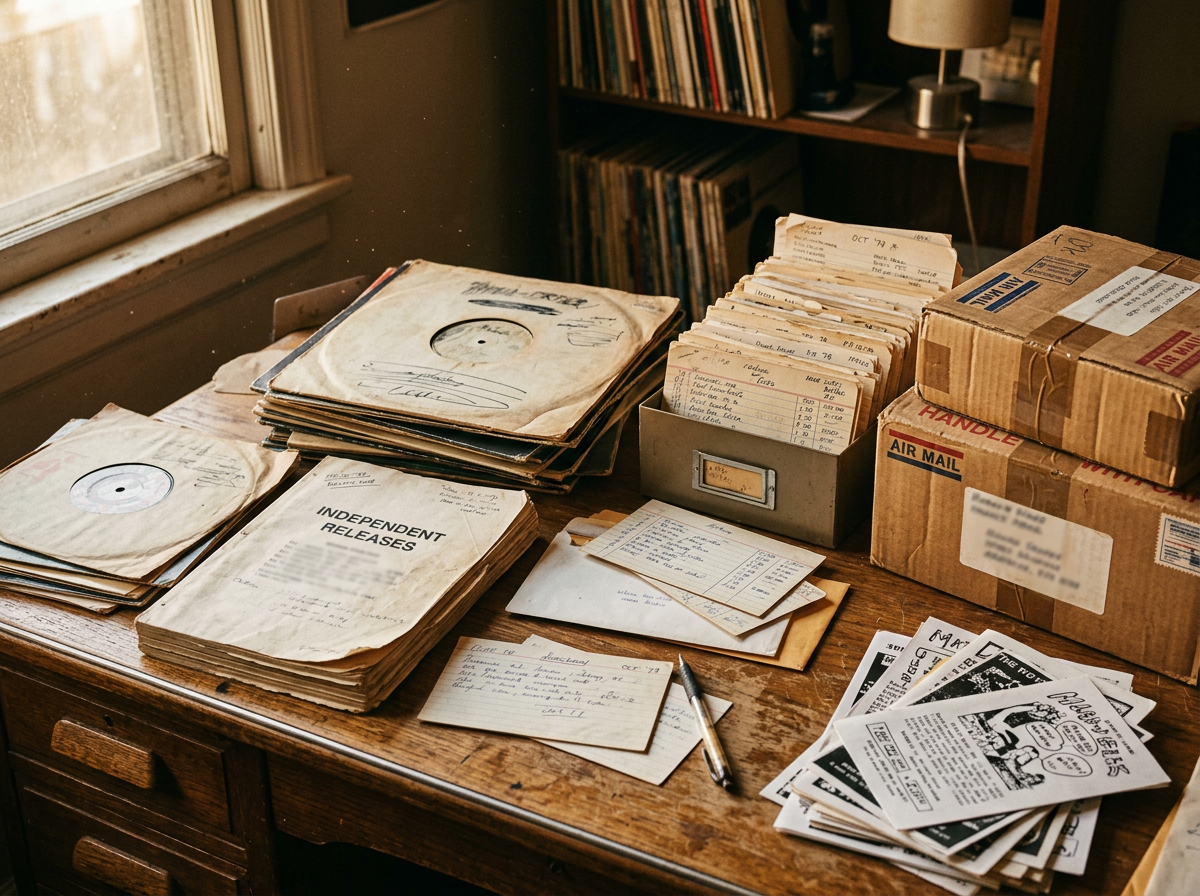
Long before digital streaming algorithms turned music discovery into a passive tap on a glass screen, finding non-commercial sound required physical navigation. In a college town flanked by flat highway miles, that journey meant crossing a threshold, catching the sharp aroma of cardboard mailers and aging vinyl sleeves, and talking to someone behind a register who treated the weekly release sheet like scripture.
Much has been written about Record Service on Green Street—the campus monolith whose bins served as the student body’s cultural town square until its doors shut in 2002. But the survival of Champaign-Urbana’s independent music community was never dependent on a single storefront.
Behind the campus bustle, in off-center commercial storefronts and cramped brick rooms, another retail ecosystem flourished. Anchored by the global mail-order reach of Parasol Records and the downtown vinyl sanctuary of Exile on Main St., C-U developed a resilient, physical trade infrastructure. These weren’t mere retail shops; they were distribution clearinghouses, postal waystations, and community banks for artists whose work lived entirely outside the corporate supply chain.
The Mail-Order Engine: Jim Kelly and the Parasol Empire
In the early 1990s, if you were a dedicated aficionado of jangly Scottish indie-pop, Scandinavian power-pop, or obscure New Zealand jangle, you didn’t look to Tower Records. You looked to an address in Urbana, Illinois.
Founded in 1991 by Jim Kelly, Parasol Records began as an exercise in curatorial fanaticism. Kelly, along with key creative collaborators like Geoff Merritt, understood that the international underground was full of brilliant, melody-driven bands whose records simply couldn’t find shelf space in American big-box chains. Operating first out of makeshift quarters and later establishing storefront roots—most visibly on South Race Street in downtown Urbana—Parasol became a lifeline for artists and obsessive listeners across the globe.
The operation functioned on multiple parallel tracks:
- The Imprints: Under banners like Parasol, Mud Records, and Hidden Agenda, Kelly gave a platform to exceptional local and regional acts (such as The Moon Seven Times, Braid, and White Town’s early work) while issuing stateside releases for overseas guitar-pop royalty.
- The Mail-Order Catalog: Long before e-commerce carts existed, Parasol printed dense, newsprint catalogs and paper order sheets. Music fans worldwide waited for these mailers like dispatches from a secret society. You marked your choices with a pen, tucked a check or money order into an envelope, and mailed it to Urbana.
- The Worldwide Micro-Economy: Packages bearing the Urbana postmark arrived on doorsteps in Tokyo, London, Melbourne, and Stockholm. At its peak, Parasol was shipping hundreds of padded mailers every week, quietly establishing Central Illinois as the North American capital for high-end indie-pop and power-pop distribution.
For local musicians, having Parasol in their backyard was transformative. If a Champaign band scraped together enough cash to press five hundred copies of a 7-inch single, Kelly didn’t just put three copies on a local consignment shelf; he placed the title into a global distribution network, shipping local vinyl directly to specialty import shops and bedroom collectors across four continents.
The Consignment Shelf as Currency: Jeff Brandt and Exile on Main St.
If Parasol provided the outbound distribution highway to the world, Exile on Main St. stepped in to anchor the physical room where local crates were dug.
When the catastrophic collapse of college-radio retail economics forced Record Service to close its doors in December 2002 after thirty-three years, an apocalyptic chill ran through local music circles. Pundits assumed file-sharing and CD burning would permanently eradicate brick-and-mortar music retail in the twin cities.
In 2004, Jeff Brandt refused that narrative.
Recognizing that downtown Champaign had lost its cultural anchor, Brandt opened Exile on Main St. (initially inside the One Main building before establishing storefront roots downtown, including its long-running tenure on Chestnut and its fixture home on West Main Street). The shop’s name nodded to the Rolling Stones, but its operational ethos was pure community utility.
Rather than chasing fleeting retail trends, Brandt doubled down on the tactile permanence of physical music. Years before the mainstream vinyl revival turned LP collecting into a lifestyle trend, Exile operated as an unpretentious haven for used vinyl, regional pressings, classic reissues, and DIY cassettes:
- The Consignment Counter: The mechanics were straightforward and artist-first. A local musician walked in with a short run of self-released CDs, 7-inches, or cassettes. Brandt logged them into the store’s consignment system with zero corporate friction or barcode barriers. If a band sold out their stack over the weekend, they picked up their cash directly at the counter, funding their next batch of gas, merch, or studio time.
- The Physical Community Hub: Beyond the bins, Exile became the default living room for the downtown’s music scene. Hand-stapled gig flyers covered the bulletin boards, local concert tickets were sold without predatory service fees, and the shop routinely hosted stripped-down, all-ages in-store performances, cramming audiences between the record racks.
- Curating the Dig: Behind the register, Brandt and his staff cultivated an inviting, deeply knowledgeable environment. It was a space where high school kids picking up their first vintage turntable received the same enthusiastic recommendations as longtime collectors searching for rare private-press soul or classic post-punk.
By reviving the independent record shop in downtown Champaign during the mid-2000s digital transition, Exile ensured that the communal ritual of flipping through bins, talking shop, and buying directly from artists survived intact for the next generation.
Packaging, Print, and the Architecture of Solvency
What sustained these hubs was a functioning, closed-loop micro-economy, not nostalgia.
In the pre-broadband era, music was inseparable from paper, ink, and plastic. The packaging was part of the musical contract:
- The Screen-Printing Nexus: Local shops worked in tandem with local screen-printers—most notably Weiskamp—where band members pulled squeegees on their own tour shirts and folded hand-screened chipboard record covers on kitchen tables.
- The Physical Trade: Consignment sales didn’t make artists wealthy, but they provided critical, immediate operating liquidity. Selling fifteen cassettes at Exile on a Saturday paid for the gasoline to get the band’s van down I-57 for a Sunday night gig in Carbondale.
- The Anti-Algorithmic Community: You could not “skip” a track with an impatient thumb swipe; you bought an album based on the artwork, the label logo, or the handwritten clerk recommendation card slipped behind the plastic sleeve.
When you handed over cash at Parasol or Exile, the money didn’t evaporate into distant corporate licensing servers. It circulated through town: the record store paid the musician, the musician bought guitar strings at a local instrument shop and gas at the neighborhood pump, and the store used the margin to order next month’s batch of blank cardboard mailers.
The Enduring Footprint
In an era where streaming platforms offer hundred-million-song libraries that leave working artists with fractional-penny payouts, the legacy of Champaign-Urbana’s independent record hubs reads less like a museum piece and more like a tactical blueprint for artistic survival.
Parasol proved that geographic isolation was an illusion; armed with taste, conviction, and an efficient postal pipeline, a tiny shop in Urbana could direct the tastes of power-pop fans worldwide. Exile on Main St. proved that the physical record shop was never just about moving units—it was about holding open a shared physical space where subcultures could gather, talk, and keep their scene alive with hand-to-hand transactions.
They didn’t just sell music to a college town. They built the wooden bins and post-office runs that kept independent culture solvent, one carefully packed box at a time.
Essential Archival Guide: Labels, Shops & Landmarks
Key Imprints & Landmark Releases
- Parasol Records (Catalog Highlights): The Jangle & Power-Pop Pipeline: Releases by regional icons like The Moon Seven Times (The Moon Seven Times, 1993), international distributions for power-pop luminaries, and early foundational domestic singles for acts like White Town.
- Mud Records (The Heavier Roster): The Indie/Post-Hardcore Branch: Parasol’s sister imprint dedicated to the heavier, angular rock sound of the midwestern underground. Key titles include early foundational releases and split 7-inches from regional powerhouses like Braid, Castor, and Sarge.
- Hidden Agenda Records: The Global Reach: The sub-label focused on licensing and distributing pristine international indie-pop and singer-songwriter catalogs (including seminal releases from the UK, Australia, and Sweden) for the North American market.
Physical Landmarks & Cultural Sites
- Parasol Records / Mail-Order Headquarters (Downtown Urbana): Historic Hub: Centered for years on South Race Street in Urbana, serving as the central warehouse, retail outlet, and packing station that processed hundreds of international mail orders each month.
- Exile on Main St. (Downtown Champaign): The Downtown Anchor: Founded in 2004 by Jeff Brandt at One Main before anchoring long-running storefronts on Chestnut and West Main Street. The store remains the definitive physical crate-digging hub, host of all-ages in-store sets, and consignment depot for local musicians.
- Record Service (Green Street, Campus Town — Closed 2002): The Predecessor: 621 E. Green Street. The 33-year titan of campus retail that established C-U’s independent retail appetite, whose closure set the stage for Exile’s mid-2000s emergence.
- Weiskamp Screen Printing (Champaign): The Physical Supply Chain: The industrial counterpart to the record bins, where musicians printed custom 7-inch record jackets, gig posters, and tour merch that fed directly into local shop consignments.