Sal's Site
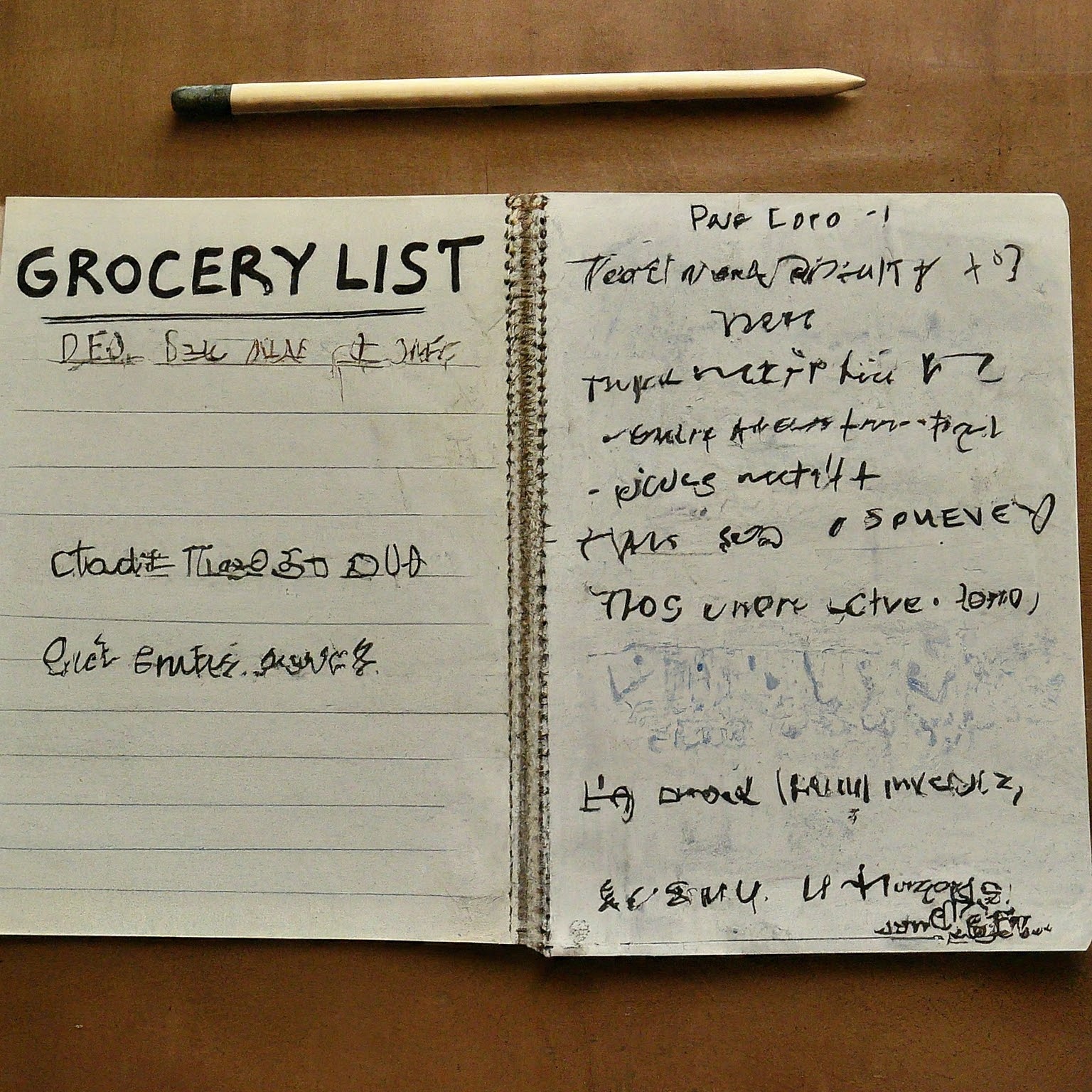
Several years ago, my wife told me about a book a friend of hers was reading called Milk Eggs Vodka: Grocery Lists Lost and Found. The book and its author, Bill Keaggy, have gained notoriety over the years, and deservedly so. The gist of Keaggy’s read, according to the author himself in the introduction, is that lists—even ones as mundane as grocery lists—can make us wonder what is happening in the lives of those who wrote them. Keaggy doesn’t just see a boring list; he thinks about “the story behind it.”
Keaggy collected thousands of discarded grocery lists and published them in his book, humorously commenting on the often sloppily written pieces. It’s these observations that give the book its kick.
One of the grocery lists, shown in the book early on, has the word “Schnucks” underlined as a sort of subhead at the top, followed by a list that encompasses “gin (Tanqueray)” and “candy for work.” Keaggy writes in the caption, “At least it doesn’t say ‘Gin (for work).’” I like this list in particular because Schnucks is a popular stop for me and my wife when we grocery shop.
Keaggy is a funny guy, and I respect where he was coming from when writing Milk Eggs Vodka. Finding depth and beauty in the mundane is a tactic often used by literary journalists, a form of journalism I’ve delved into myself. It takes practice to reveal the extraordinary in the ordinary, and it can be addictive when you get it right.
An even more interesting book might be one about thrown-away notes that cover a wide range of topics, and maybe such a book exists. Reading notes, after all, can be as mundane as checking your phone. But the shared words on a piece of paper can also be more dramatic, perhaps your girlfriend of four months breaking up with you. Or maybe a more hopeful message that says she can’t wait to see you when she gets home from work and, by the way, would you please feed the pets? A personalized note can encompass any number of things.
Which brings me now to scratch paper, of which I’m a huge fan. Useable scratch paper in our family, and at work, is paper that has stuff written on one side of it and nothing (or very little) on the other. As my stepson, Logan, has progressed through school, he or my wife, about twice a year, will leave me a mound of scratch paper to sift through. I search every page to see if it can be salvaged. The ones that are blank on the back get saved, stuffed into desk drawers or nooks and crannies for an eternity as I use them for important scrawling. The paper that’s filled up on both sides gets recycled.
The impetus for saving all this paper used to be geared toward the environment. By writing thoroughly on both sides of sheets of paper and then recycling them, I figured I was saving a few trees here and there. But the practice has evolved into something far more special: after I look them over, many of these pieces of paper take me backward in time, spurring reflection.
After I look them over, many of these pieces of paper take me backward in time, spurring reflection.
Lots of the saved pages have Logan’s past graded schoolwork, revealing the good marks, the mediocre results, and the occasional fails. Like a weary man from the future gauging relics from the past, I ponder homework and quizzes Logan and his classmates once ruminated on and answered as best they could, efforts I never would have seen if I hadn’t saved these sheets. This is work that Logan and his peers have probably long since forgotten, yet these pages have helped me at times rediscover my past as I think beyond the content on the paper.
These old pages have showed me math that I don’t miss, short tests I don’t want to retake, practice spelling tests that feel archaic but are probably necessary, and writing assignments that were more my speed. Logan went to Catholic schools for most of grade school and all of high school, so I’ve spent more time than I care to admit absorbing some of the poignant religious readings he was assigned. I too went to a Catholic grade school, and I miss the earnest teachings that focus on civility, goodness, and caring, doing what’s right in life with an idealistic outlook unstained by cynicism.
I love it when Logan’s old papers are dated. When I see the penciled-in dates he wrote at the top of the page, maybe 3/7/14, for instance, it takes me straight back to that time. I think of myself and what I was doing, as well as Jill and I together, and how young Logan was. Heck, I recall how relatively young Jill and I were, how full of hope and love.
One day I came across a scratch-paper page dated 9/28/16. It’s labeled Lesson Quiz | 5-2 and contains several fill-in-the-blank questions at the top. Logan got them all correct. Here’s how they read, with the bolded words showing the right answers:
- Your self-concept is the way you view yourself overall.
- Good self-esteem helps you to have confidence around others.
- If you have high self-esteem, you are more likely to respect others and accept their differences.
- Some people depend on the media to decide how to act, what to buy and what to wear without realizing that it doesn’t always present a true picture of real life.
- Being positive helps you relate better to others and respect their life experiences.
I haven’t used the back of this sheet as scratch paper, and I haven’t recycled it. Instead, I’ve saved it. I’m 50 years old, and I can’t bring myself to part with the information on this sheet. In fact, I read it fairly often. It helps me.
Logan is now attending community college as a freshman, and I suspect he’ll be providing me with way less scratch paper in the future. That’s okay; I’ve got tons sitting around. And every time I pull a sheet out to conduct my all-important scrawling, I’ll continue to check the front of the sheet, and then the back. To see where it might take me. To discover what I may relearn.