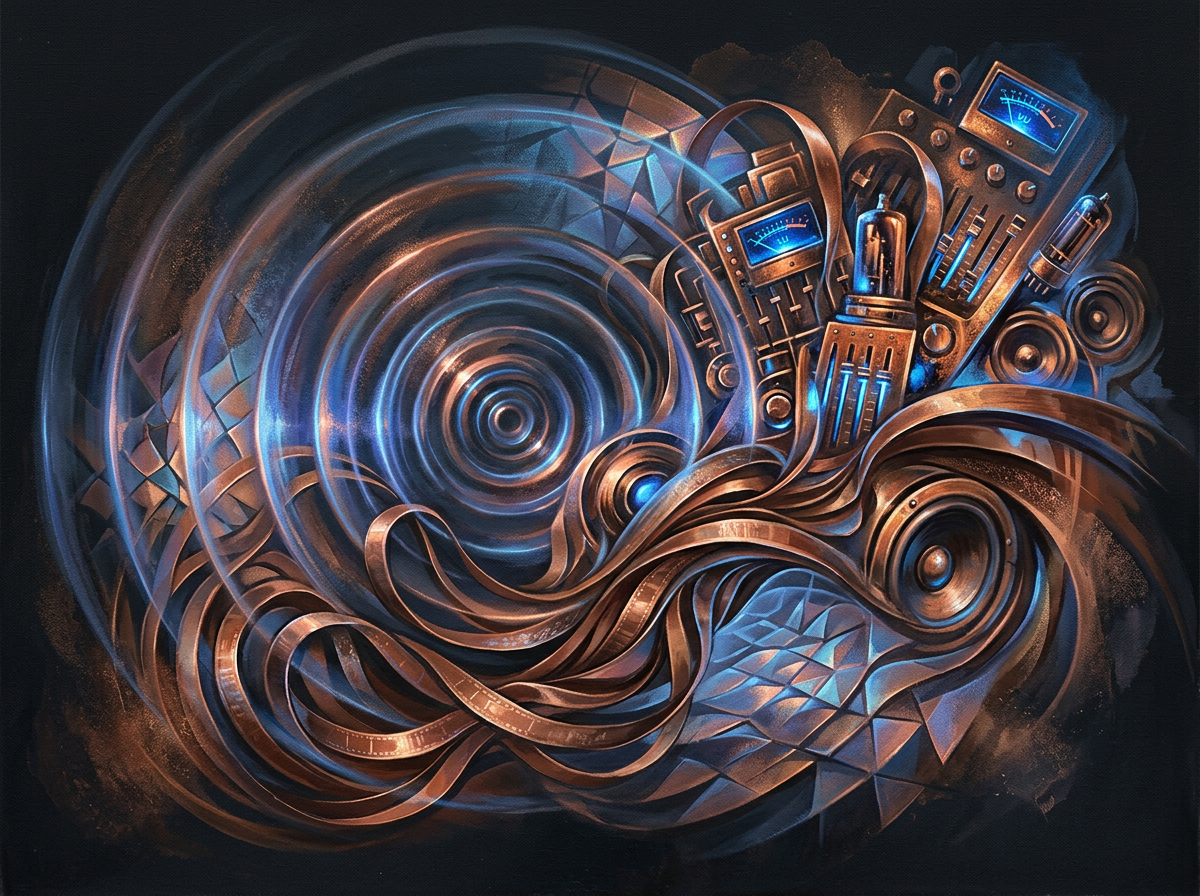
Years ago, while taking a recording class taught by veteran producer Mark Rubel at Pogo Studio in downtown Champaign, I had an early realization about the physics of making records: what you hear on tape is rarely what actually happened in the room.
Mark had a way of opening up the control room that stripped away romance and replaced it with wonder. You learned quickly that audio engineering is part acoustic science, part psychology, and part mechanical illusion. A microphone placed two inches to the left doesn’t just change frequency response—it changes emotional urgency. A compressor doesn’t just manage electrical volume—it dictates the physical swagger of a performance.
Long before digital workstations allowed anyone to snap notes to an infinite grid or fix pitch with a mouse click, making a record meant wrestling with real-world physics. You pushed air, heated vacuum tubes, and trusted spinning reels of magnetic tape.
Nowhere was that battle fought more aggressively than in the high-stakes control rooms of 1980s hard rock.
The Death of the Documentary Approach
If you listen to landmark rock records from the early 1970s—early Led Zeppelin, Aerosmith, or Deep Purple—the production philosophy was essentially documentarian. The studio functioned as an acoustic mirror. A band set up in a room, an engineer hung dynamic microphones in front of guitar cabs and drum skins, and the tape captured the kinetic, imperfect energy of musicians playing together in real time.
By the dawn of the 1980s, that mirror shattered.
Driven by the competitive pressure of FM radio, burgeoning digital technology, and ballooning production budgets, producers like Robert John “Mutt” Lange, Bob Rock, and Michael Wagener stopped treating the studio as a passive capture room. They turned it into an active, high-gain musical instrument.
They didn’t want an honest snapshot of four guys sweating in a garage. They wanted a hyper-real, three-dimensional monument of sound capable of exploding out of dashboard speakers, boomboxes, and arena PA systems with surgical clarity.
Engineering the Impossible
To build that scale, engineers had to invent new physical rules on the fly:
- Shattering Acoustic Space: When traditional tracking booths sounded too polite, engineers ran 100-foot snakes down concrete stairwells and into industrial elevator shafts. When an SSL talkback compressor accidentally clamped down on Phil Collins’s drum kit at the Townhouse, it birthed the gated snare—an explosive sonic punch that cut off into dead silence, instantly solving the problem of long reverb tails muddying up dense rhythm sections.
- The Architecture of Iron: Saturated tube amplifiers like the Marshall JCM800 were pushed past factory tolerances. To tame harsh high frequencies, engineers discovered the microscopic art of off-axis microphone placement, angling capsules 45 degrees to shave off piercing 4kHz speaker fizz while preserving mid-range bark.
- The Layering Obsession: Instead of accepting the natural harmonic clash of six distorted guitar strings vibrating simultaneously, producers often broke chords down into individual single-note passes, tuning every string with a strobe tuner between takes. Vocalists tracked multi-tiered harmony inversions dozens of times to build towering, phase-rich choirs that could cut straight through walls of overdriven amplifiers.
It was an exhausting, high-wire act. Tracking marathons dragged on for months—and in the case of Def Leppard’s Hysteria, across years and millions of dollars of unrecouped debt. Master tapes shed oxide, assistant engineers cut 2-inch tape with razor blades at 3:00 AM, and mixes were regularly dragged into studio parking lots to be tested through factory car stereos before anyone signed off on a final master.
The Craft Behind the Glass
When the grunge wave arrived in the early 1990s, the high-gloss aesthetic of the 1980s was pushed aside in favor of dry, stripped-back realism. But decades later, when modern pop, rock, and country producers build massive radio mixes, they aren’t reaching for low-fidelity garage tapes—they are using the 1980s control-room playbook. Transient triggers, micro-pitch vocal widening, sidechained sub-bass, and surgical frequency carving all trace their lineage back to that relentless analog arms race.
Great records don’t happen by accident. They are built through obsessive curiosity, technical discipline, and the courage to push hardware deep into the red.
Exploring the Control Room Further
I’ve spent the past several months deep in the technical archives, session histories, and gear schematics of that transformative decade to deconstruct exactly how those monumental sounds were captured.
The result is a brand-new book: 50 Studio Secrets That Defined 1980s Hard Rock, launching my new series, Behind the Glass: Chronicles of Rock, Gear & Studio Lore.
Broken down into fifty concise, technical, and battle-tested entries, it unpacks the modified amplifier heads, gated drum physics, vocal harmony science, and happy accidents behind the biggest albums of the era.
If you love guitar tone, analog studio craft, or the untold human battles fought behind the console, you can grab your copy on Amazon:
👉 Get 50 Studio Secrets That Defined 1980s Hard Rock on Amazon
(Available as a Kindle eBook, an audiobook, and enrolled in Kindle Unlimited.)