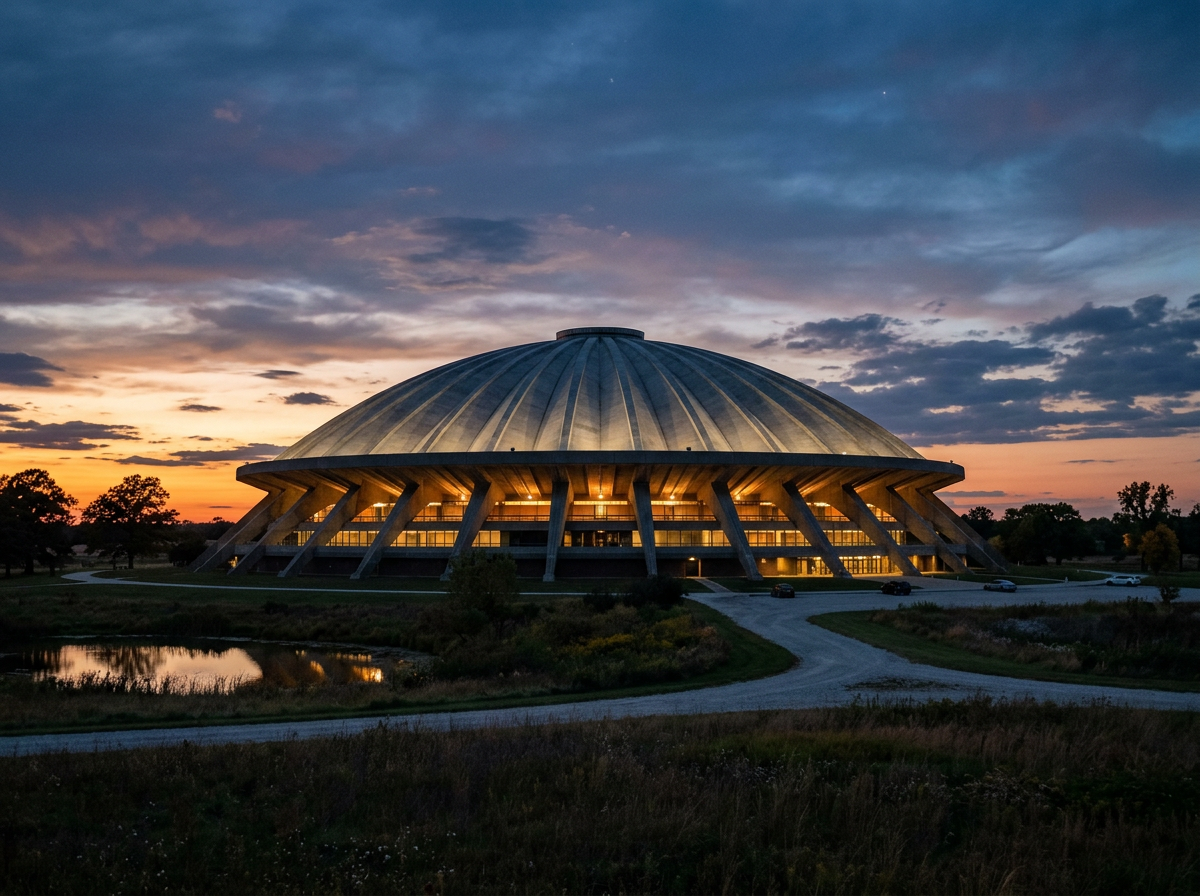

Locals called it “the mushroom,” “the flying saucer,” or simply “the Hall.” Completed in 1963 and designed by modernist architect Max Abramovitz, Assembly Hall was an engineering wonder of the post-war world. Spanning four hundred feet across without a single interior pillar or center support column, the building was anchored by an edge-supported, post-tensioned concrete dome held together by miles of steel wire wrapped under immense mechanical tension. The result was a cavernous, bowl-shaped amphitheater offering pure, unobstructed sightlines from every single seat.
Rising out of the flat prairie south of campus, the structure looks less like a midwestern sports venue and more like a celestial spacecraft that missed its coordinates and gently touched down in Champaign.
While campus planners celebrated it as a basketball shrine and civic auditorium, touring rock production crews barreling down Interstate 57 quickly realized something else entirely: it was an echo chamber of titanic proportions, built to withstand—and amplify—pure, unadulterated volume.
The true trial by fire arrived on a freezing Saturday night: November 15, 1969.
The Rolling Stones were in the midst of their mythic 1969 American Tour—a cross-country trek that would culminate three weeks later in the tragedy of Altamont and be immortalized on the live album Get Yer Ya-Ya’s Out! Between multi-night stands in Detroit and Chicago, the tour’s convoy of trucks and limousines pulled off the two-lane bypass and rolled toward Fourth Street.
Backstage in the low-ceilinged concrete tunnels usually reserved for Big Ten athletic gear, the atmosphere was thick with blue cigarette smoke, cheap bourbon, and nervous college security guards wondering what, exactly, the university had agreed to host.
Up in the arena bowl, more than sixteen thousand fans were crammed shoulder-to-shoulder, spilling down from the upper tiers to the wooden hardwood floor. There was no theatrical catwalk, no high-definition video screens, no laser packages. There was only a low wooden stage erected at one end of the floor and a towering wall of Ampeg SVT amplifiers—monolithic stacks that the Stones were road-testing for the very first time, capable of generating hundreds of watts of raw, ear-shattering guitar juice.
When Mick Jagger strutted out into the glare of the carbon-arc spotlights—flanked by Keith Richards slinging a dark Gibson Les Paul and Mick Taylor armed with a cherry-red SG—the roar bouncing off the concrete ceiling sounded like a jet engine warming up inside a silo.
As Charlie Watts kicked into the syncopated, four-on-the-floor thud of “Jumpin’ Jack Flash,” the sound wave didn’t just fill the arena; it ricocheted around Abramovitz’s concrete dome with dizzying force. Richards’ opening riff ripped through the room like sheet metal tearing in two, while Jagger, swigging from a bottle and whipping a long scarf around his neck, transformed a university basketball arena into a sweaty, roaring rock-and-roll cathedral.
For two hours, the band tore through “Sympathy for the Devil,” “Midnight Rambler,” and “Street Fighting Man,” proving that the dome’s acoustics, while notoriously boomy, could turn a blues riff into a physical event that rattled the rib cages of farm kids and college radicals alike.
By the time the amplifiers cooled and the tour buses disappeared into the dark Illinois night, a precedent had been established. Assembly Hall wasn’t just an arena on a prairie campus; it was a bona fide heavyweight crucible, ready to swallow the biggest tours on the planet.
The King in the Cornfields: October 1976
If the Rolling Stones had proven that Assembly Hall could handle raw, rebellious British swagger, seven years later the venue faced an entirely different cultural tsunami: the spectacle of Elvis Presley.
On the evening of October 22, 1976—less than ten months before his untimely death—the King rolled into Champaign. Outside, Fourth Street was gridlocked for miles. Tailgates, station wagons, and family sedans lined the curb as three generations of fans braved the autumn chill, clutching flashcubes, binoculars, and homemade banners. Inside, the sheer scale of the production was staggering. Elvis traveled not merely with a band, but with an acoustic army: the muscular TCB Band led by guitarist James Burton, the gospel harmonies of J.D. Sumner & the Stamps, the Sweet Inspirations, and a full, booming brass orchestra.
When the dramatic kettle-drum thunder of Strauss’s Also Sprach Zarathustra began to rumble, bouncing off Abramovitz’s concrete dome, the collective roar from sixteen thousand spectators was deafening.
Elvis stepped into the spotlight draped in his iconic, ornate white jumpsuit, gold chains flashing against the stage lights. While his physical stamina had begun to show the wear and tear of a relentless touring grind, the moment he grabbed the microphone to launch into “See See Rider,” the charisma was undiminished. James Burton’s telecaster chicken-picking cut through the hall’s natural reverb, and when Elvis leaned into dramatic, soaring vocal performances like “Hurt” or his show-closing “Can’t Help Falling in Love,” his operatic vibrato hung suspended in the cavernous room like a physical presence.
Champaign had hosted symphony orchestras, basketball champions, and counter-culture icons, but the night Elvis took the stage, the concrete mushroom served as a glittering Las Vegas showroom dropped squarely into the cornfields.
The 1980s Arena Dominance: Hometown Kings and In-The-Round Spectacle
As the 1980s arrived, live music shifted from polite seated auditoriums to high-decibel, pyrotechnic excess. The touring industry became an arms race of lighting trusses, smoke machines, and multi-truck sound systems—and Assembly Hall’s unique architecture gave it an unexpected superpower.
Because the dome had been constructed with zero interior support columns, there were no blocked views or dead spots. Promoters and stage designers realized the room was a blank canvas for stagecraft that other Midwestern arenas simply couldn’t accommodate.
The decade belonged to power chords and big hair, starting with a triumphant homecoming.
REO Speedwagon: The Return of the Prairie Princes
No band understood the geography of Central Illinois better than REO Speedwagon. Having cut their teeth in the late 1960s and early ’70s playing fraternity basements, barn parties, and legendary local dives like the Red Lion on Green Street, their return in the wake of 1981’s multi-platinum juggernaut Hi Infidelity was a victory lap of historic proportions.
When Kevin Cronin stepped to the piano on the Assembly Hall hardwood to strike the opening chords of “Keep On Loving You,” the crowd sang along so loudly it nearly swallowed the soundboard. Neal Doughty’s keyboards and Gary Richrath’s soaring, melodic Gibson Les Paul solos resonated through the room with personal resonance: for thousands of local fans, this wasn’t just a touring arena act on MTV—it was their guys, selling out the biggest building in the county.
Def Leppard: Conquering the Center of the Floor
By late 1987 and 1988, British hard-rock heavyweights Def Leppard had completely revolutionized the arena format with their Hysteria world tour. Rather than setting up a standard stage at the far end of the floor, the band conceived the daring “In-The-Round” concept—a massive, diamond-shaped stage dropped dead-center into the arena bowl, surrounded by fans on all 360 degrees.
Assembly Hall was practically engineered for this exact show.
Without a single pillar obstructing the sightlines, Joe Elliott, Phil Collen, Steve Clark, and Rick Savage could sprint across four distinct corners of the stage, engaging every tier of the concrete amphitheater simultaneously. High above the floor, a towering circular lighting rig shaped like a flying saucer drifted and tilted in unison with the music, perfectly mirroring the curved dome of the building itself.
When Rick Allen hammered the electronic kick drums and triggered samples on “Pour Some Sugar on Me” and “Animal,” the four-way PA system hurled multi-layered guitar harmonies in every direction. The sound rattled the lower concrete concourse, delivering a dizzying, immersive sensory overload that set the benchmark for modern stadium production.
Bon Jovi: The Decade’s Climax
Following close behind was the unstoppable juggernaut of Bon Jovi. Touring behind Slippery When Wet and later New Jersey, Jon Bon Jovi and Richie Sambora transformed the Hall into an explosive, sing-along chorus. With Jon flying across catwalks suspended from Abramovitz’s steel tension cables and Sambora’s talk-box guitar lines driving “Livin’ on a Prayer,” the room reached a fever pitch of 1980s pop-metal euphoria.
Throughout the decade, the venue became an indispensable Midwestern rite of passage: Aerosmith, Van Halen, Ozzy Osbourne, and Rush all rumbled through town on eighteen-wheelers, turning the concrete flying saucer on Fourth Street into the premier proving ground for hard rock royalty.
The Alternative Wave & The Dave Matthews Phenomenon
As the neon sheen of 1980s hair metal burned off, Assembly Hall transformed once again, reflecting the dramatic sea change sweeping popular music. The hairspray and leather trousers vanished, replaced by flannel shirts, ripped denim, and a massive influx of Midwestern college crowds hungry for alternative rock, jam improvisation, and stadium-scale pop-punk.
Throughout the 1990s, the venue became a critical campus crossroads:
- The Grunge & Alt-Rock Takeover: Bands that had started in sweaty subterranean clubs found themselves staring up at Abramovitz’s massive concrete ribs. The Smashing Pumpkins—with deep Illinois roots—brought their swirling, distortion-heavy Mellon Collie and the Infinite Sadness tour to the Hall in 1996, turning the concrete bowl into a cavern of oceanic shoegaze and visceral guitar crunch. Tours from acts like Pearl Jam and Stone Temple Pilots proved that the raw, brooding angst of modern rock could fill an arena built for basketball champions without losing its serrated edge.
- The Arena-Scale Jam: No single act conquered the venue’s college-town demographic in the late 1990s and early 2000s quite like the Dave Matthews Band. Treating Champaign as an essential annual Midwestern hub, DMB turned Assembly Hall into an ecstatic, campus-wide holiday. Caravan convoys packed with students from across the Big Ten rolled into the parking lots hours before doors opened. Inside, the band launched into marathon, two-and-a-half-hour sets where Carter Beauford’s polyrhythmic drumming and Boyd Tinsley’s frenetic violin leads bounced cleanly off the concrete ceiling, turning songs like “Ants Marching” and “Two Step” into thunderous, sixteen-thousand-voice sing-alongs.
- Country Mega-Tours: Parallel to the rock circuit, modern country found an unshakeable home under the dome. Garth Brooks swept through during his multi-night, mid-90s commercial peak, flying from harnesses suspended above the hardwood, while Alan Jackson, George Strait, and later Kenny Chesney proved that downstate Illinois concertgoers could turn Fourth Street into a honky-tonk celebration.
The Evolution: Concrete Mushroom to State Farm Center
By the 2010s, Assembly Hall had carried the physical and sonic weight of fifty years of relentless touring. Touring productions had grown exponentially heavier; modern lighting rigs, LED video walls, and arena audio arrays demanded advanced rigging capacities, climate-controlled comfort, and backstage infrastructure that a 1963 building simply wasn’t designed to support.
The university faced a crucial historic choice: replace the aging concrete icon with a nondescript modern box, or preserve its irreplaceable architectural identity while gutting and rebuilding its internal nervous system.
Wisely, they chose preservation.
Beginning in 2014, the venue underwent an exhaustive, multi-year, $169.5 million renovation, reopening as the State Farm Center.
The overhaul pulled off an engineering feat as bold as Abramovitz’s original 1963 blueprint:
- Structural Reverence: The iconic exterior silhouette—the unmistakable fluted concrete flying saucer rising over the prairie—remained untouched, preserving the visual calling card familiar to every student and resident of Central Illinois.
- Acoustic & Production Upgrades: Inside, the old, notoriously boomy bare-concrete ring was fitted with state-of-the-art acoustic baffle treatments, lowering echo times and dramatically sharpening front-of-house clarity. Upgraded rigging grids could now hold hundreds of thousands of pounds of modern theatrical lighting, automated trusses, and video systems.
- Modern Amenities: Cramped concourses and aging bleachers were replaced with widened walkways, club suites, air conditioning, and enhanced production loading bays, ensuring that modern pop titans, hip-hop stars, and classic rock legends could park their multi-bus convoys without logistical headaches.
The Concrete UFO That Never Left
While the blue-and-orange sign out front now reads State Farm Center, to the generations of fans who lived through its sonic history, it will always be Assembly Hall.
It is the building where farm kids from Douglas County sat three rows away from fraternity brothers to scream along with Mick Jagger; where high schoolers bought their first concert ticket to watch Kevin Cronin play piano or Joe Elliott run around a rotating center stage; and where an entire generation of college students shared a communal rhythm to the beat of an acoustic guitar.
In a flat landscape where the eye can see for miles, Max Abramovitz gave Champaign-Urbana a concrete monument that defied gravity. For more than six decades, the musicians who plugged in beneath its dome ensured that the sound defying gravity inside was even louder.
Essential Concert Timeline & Archival Guide: Assembly Hall
Chronological Landmark Concerts
The Rolling Stones (1969 American Tour)
November 15, 1969
Road-testing monolithic Ampeg SVT amp stacks to a sold-out bowl of 16,000, establishing the venue as a premier tour stop just weeks before Altamont.
Elvis Presley & The TCB Band
October 22, 1976
The King brought his full Vegas orchestra and gospel vocal sections to Fourth Street, less than a year before his death.
REO Speedwagon (Hi Infidelity Tour)
1981
A triumphant hometown arena victory lap for the former local bar-band kings, packing the rafters following multi-platinum success.
Def Leppard (Hysteria Tour In-The-Round)
October 28, 1987 / 1988
A masterclass in 360-degree arena staging, utilizing the column-free dome for a center-stage setup and UFO-like moving lighting trusses.
Bon Jovi (Slippery When Wet / New Jersey Tours)
1987 & 1989
Peak 1980s arena-rock euphoria, turning the concrete ceiling into a resonant chamber for screaming anthems.
The Smashing Pumpkins (Mellon Collie Tour)
1996
Swirling alternative rock and heavy distortion, demonstrating that 1990s grunge and alt-rock had graduated to stadium-scale rooms.
The Dave Matthews Band Resurgence
Late 1990s – 2000s
Annual Big Ten college gatherings featuring marathon two-and-a-half-hour jam-heavy sets and massive parking lot tailgates.
Architectural & Archival Footnotes
- The Edge-Supported Post-Tensioned Dome (1963): The Engineering Marvel: Designed by Max Abramovitz (Harrison & Abramovitz), the building features a 400-foot clear-span circular concrete roof supported by 614 miles of high-tensile steel wire wrapped under immense mechanical tension around the outer rim.
- The Production Crucible: Sightlines vs. Reverb: With no interior support pillars to obstruct sightlines, the room became a favorite for touring production managers, even as front-of-house sound engineers fought its notorious two-second concrete flutter echo using heavy drapery and delayed speaker arrays.
- The $169.5 Million Modernization (2014–2016): Preserving the UFO: The comprehensive structural and acoustic overhaul that transformed Assembly Hall into the State Farm Center, adding modern acoustic baffles, heavy-capacity rigging grids, and premium amenities without altering the historic exterior concrete dome.