How a Central Illinois indie powerhouse turned tour mileage, tech literacy, and blue-collar ethics into a lifetime of art.
The Champaign-Urbana Crucible: A Working-Class DIY Foundation
Before major-label A&R scouts started combing through central Illinois cornfields with corporate checkbooks, Champaign-Urbana was an isolated, self-sustaining island of noise. Anchored by the sprawling campus of the University of Illinois, the twin cities existed two hours south of Chicago and three hours northeast of St. Louis—far enough from industry capitals that local musicians had to invent their own ecosystem. In the late 1980s, that world was fueled by an intimate, closed-loop pipeline: the legendary Record Service on Green Street, commercial student-run powerhouse WPGU (107.1 FM), and the sweat-soaked hardwood floors of Mabel’s and the original Blind Pig on Walnut Street.
Record Service was the campus’s cultural town square, a record store where local bands consigned self-pressed 7-inches and cassettes, read cork-board bulletin notices for gear and rhythm sections, and studied underground imports curated by clerk-encyclopedias. Just down the road, WPGU pumped those same indie singles over a massive broadcast radius, sandwiching local cuts from Poster Children, Didjits, and Hum alongside national college-rock heavyweights. Hearing a home-recorded tape on the radio drove kids straight down Green Street into Record Service, and then out the door to packed weekend bills at Mabel’s, where touring trailblazers like Hüsker Dü and Black Flag shared floor space with local openers.
In this fertile pocket, Poster Children—founded in 1987 by Rick Valentin and Rose Marshack alongside a kinetic sequence of early drummers—forged a work ethic rooted in physical craft. They spent long shifts at Weiskamp Screen Printing learning squeegees, emulsion, and cost margins, hand-pressing their own shirts and folding cardboard 7-inch record sleeves on apartment floors.

In her memoir, Play Like a Man: My Life in Poster Children, Marshack captures the ethos that kept the band grounded through this whirlwind. The title stems from blunt advice from her father—an exhortation not to mimic masculinity, but to refuse to play small or tentative in a room full of loud men. Slapping a bass guitar over her shoulder, Marshack stepped into a male-dominated post-punk landscape where female instrumentalists were routinely treated as novelties. She answered with sheer volume, razor-sharp rhythmic precision, and an ironclad band philosophy: every broken-down Econoline on I-74, blown amp, or canceled show wasn’t a defeat—it was a “Learning Experience.”
The Sonic Evolution: Steve Albini Grit to the Junior Citizen Watershed
By 1991, Poster Children’s unrelenting tour miles translated into their seminal underground full-length record, Daisy Chain Reaction. Engineered by Steve Albini in Chicago and released on Twin/Tone (later picked up by Sub Pop and Sire), the album captured the band at their rawest: sharp, dynamic, post-hardcore stop-starts; dissonant ringing chords; and a hyper-kinetic rhythm section that felt permanently coiled to strike. Tracks like “If You See Kay” and “Chain Reaction” balanced math-rock precision with explosive anthemic energy, catching the ear of major labels scrambling for Midwestern authenticity in the wake of Nevermind.
Signing with Sire/Reprise brought wider resources without diluting their bite. Their 1994 major-label debut, Tool of the Man, honed their jagged edges with thick, punchy production while keeping their cynical wit and structural complexity intact. But it was their 1995 follow-up, Junior Citizen, recorded at Smart Studios in Madison, Wisconsin, that marked the apex of their sonic and technological vision.
Junior Citizen struck a rare balance between pop-hook immediacy and underground bite:
- “Junior Citizen”: The explosive title track served as a manifesto against cultural numbness, rallying against the “empire of the bored” with driving, relentless basslines and soaring choruses.
- “He’s My Star”: An infectious, should-have-been radio staple that cleverly re-contextualized pop-culture idolatry (famously sparked by David Hasselhoff’s ubiquitous German fame) inside driving power-pop crunch.
- “Drug I Need” & “Revolution Year Zero”: Pushed their dynamic spectrum from slow, heavy psychedelic stomps into high-speed, math-inflected sonic squalls.
Beyond the music, Junior Citizen arrived years ahead of the digital curve as one of rock’s first Enhanced CDs. Leveraging Valentin’s and Marshack’s backgrounds in computer science, the disc contained an interactive CD-ROM component featuring behind-the-scenes video footage, touring trivia, discographies, and direct-access computer animations. Long before web road blogs or social media feeds existed, Poster Children were using technology to bridge the gap between their Midwestern home base and their global audience, proving that technical self-reliance and artistic expression were two sides of the same coin.
Life in the Econoline: Tour Logistics, Sisterhood, and Survival

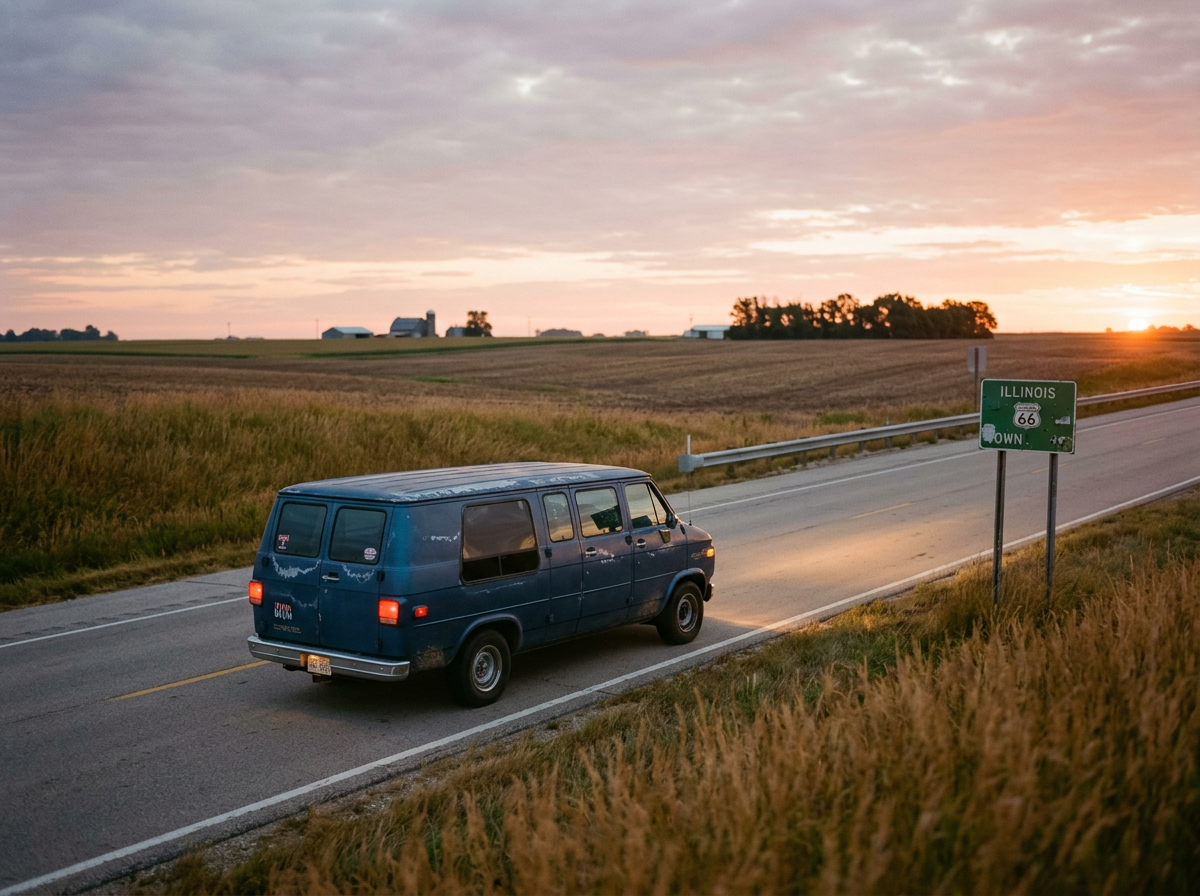
The engine of Poster Children’s longevity was never major-label promotional budgets; it was the odometer of their Ford Econoline van. Touring upwards of 200 to 300 nights a year, the band treated the North American highway system as their true home address. They mapped out routes using physical paper road atlases, slept on the floors of generous college radio DJs, and instituted ruthless operational efficiency to keep the machine running. In Play Like a Man, Marshack pulls back the curtain on this unglamorous grind, detailing the strict logistics required to keep four people sane, solvent, and safe while hurtling across thousands of miles of interstate.
That relentless road ethic reached a national high-water mark in the summer of 1995, when Poster Children were tapped to play the second stage on the massive Lollapalooza tour. Sharing grounds with mainstage juggernauts like Hole, Sonic Youth, and Beck, while alternating blistering afternoon sets on the side stage alongside peers like The Jesus Lizard, Yo La Tengo, and Brainiac, the festival was a microcosm of alternative rock’s mid-’90s cultural peak. Yet while the festival machinery was massive and corporate, Poster Children maintained their blue-collar autonomy. They operated as a self-contained unit amid the circus, using early mobile technology to draft and upload some of the earliest online tour diaries from festival parking lots, establishing direct digital lines back to their fans long before the advent of social media.
For Marshack, life on the road carried an added layer of navigation as a woman commanding the low end in a scene overwhelmingly populated by men. Rather than retreating into isolation, she forged an informal, deeply supportive “bass sisterhood” with contemporary female players carving out their own spaces across the indie underground—musicians like Kim Gordon of Sonic Youth, Candice Belanoff of The Chisel, and Heidi Ore of Tsunami. These bonds provided a vital counterweight to the casual sexism of venue bouncers who routinely mistook female band members for girlfriends, as well as sound engineers who spoke down to them at soundcheck. Marshack responded with unassailable technical precision, heavy amplifier tone, and sheer stage command.
Surviving decades inside this high-pressure environment required mental and spiritual endurance. Marshack grounded herself through the practice of martial arts, Eastern philosophy, and Zen mindfulness, learning to strip away industry ego and the volatile emotional swings of the music business. The goal was never fleeting rock-star mythology, but sustained artistic presence. By approaching the road as a disciplined craft and every crisis as a manageable learning experience, the Poster Children transformed the grueling realities of van life into a sustainable model for creative survival.
The Enduring Legacy: From the Prairie to the Classroom
When the major-label feeding frenzy of the 1990s inevitably cooled, the Poster Children didn’t collapse under the weight of dashed commercial expectations. While many of their peers were dropped, disillusioned, or disbanded when corporate radio pivoted, Rick Valentin and Rose Marshack simply did what they had always done: they reclaimed full control of their labor. Transitioning smoothly back into total independence, they launched their own imprint, Twelve Inch Records, and released records like RTFM (1997) and The Iditarod (2004). They embraced mp3 distribution, home recording, and direct fan engagement when the major labels were still treating the internet as an existential threat. For Poster Children, DIY wasn’t a nostalgic 1993 branding tag; it was a permanent operational strategy.
That fluency with emerging technology, creative grit, and systems-level problem solving eventually carried Valentin and Marshack from the back of the Econoline to university lecture halls. Both joined the faculty at Illinois State University in Normal, transitioning into tenured professors in the Arts Technology Program (now the Creative Technologies Program). Teaching new generations about audio production, game design, digital media, and the business of independent art, they brought the exact lessons forged at Weiskamp Screen Printing and on the Lollapalooza second stage directly into higher education. Their academic careers are not a departure from their rock-and-roll history, but its natural culmination—demystifying technology and showing young creatives how to own their tools and build sustainable artistic lives.
Today, the Poster Children stand as essential architects of the Champaign-Urbana musical legacy alongside Hum, Braid, and American Football. They proved that an underground Midwestern band could maintain its sonic bite, tour the world, experiment on major-label dimes, and walk away with their integrity, creative ownership, and community ties intact. As captured in Marshack’s Play Like a Man, their real triumph wasn’t a temporary pop chart placement—it was building an enduring, self-reliant blueprint that shows how music, education, and work ethic can create a life of lasting art.