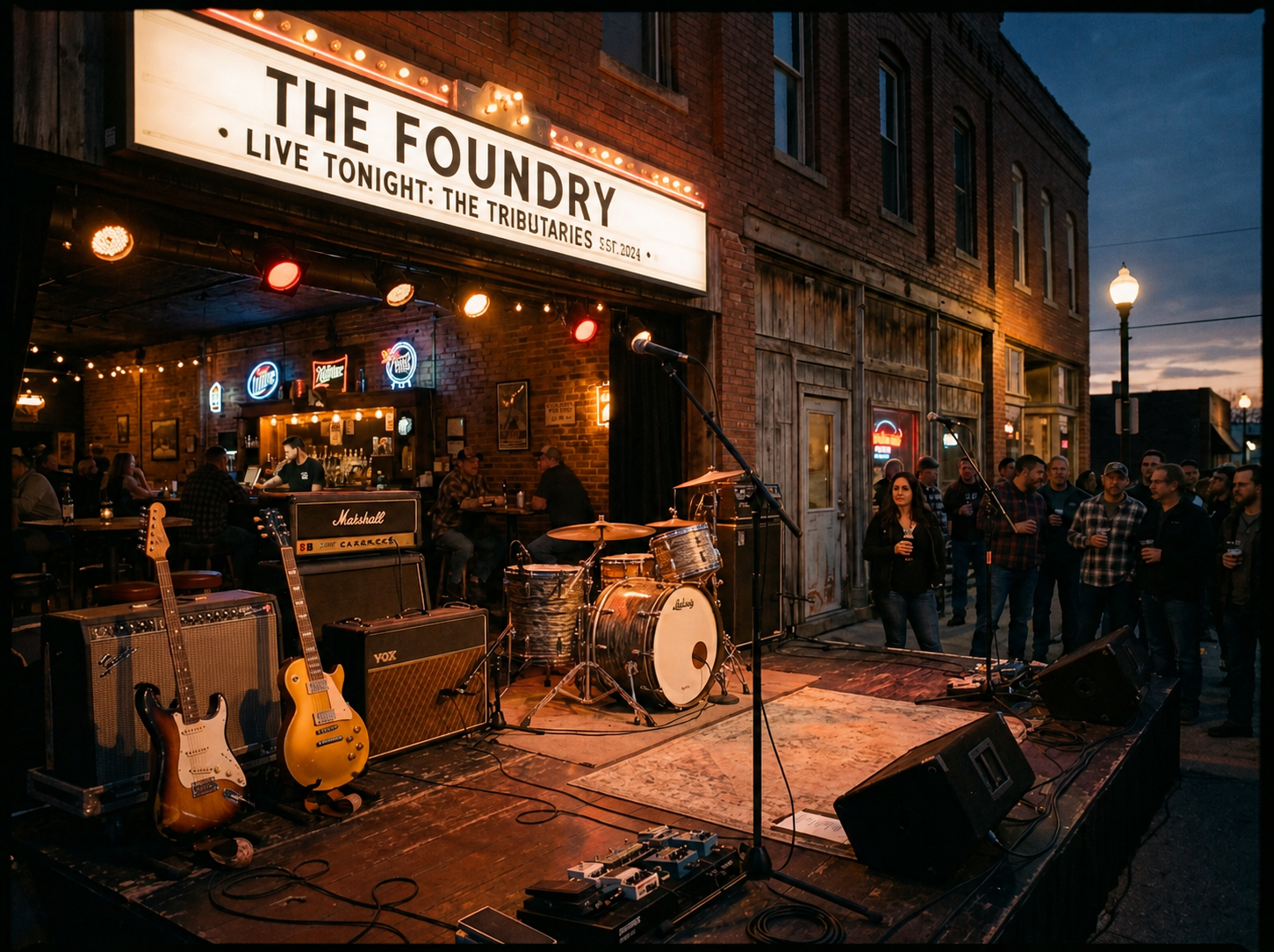
Two hours south of Chicago, surrounded by flat miles of cornfields and interstate, Champaign-Urbana operated in the 1990s as an accidental sonic incubator. The twin cities were isolated enough to escape the gravitational pull of Chicago’s industry, yet continually supercharged by the kinetic churn of the University of Illinois. With college radio station WPGU pumping alternative sounds across campus, independent record racks serving as community nerve centers, and drafty Urbana basements doubling as venues, local musicians built an entire ecosystem out of necessity.

The physical stages anchored everything. On any given weekend, downtown Champaign’s The Blind Pig Co. was a humid, brick-walled pressure cooker where sweat condensed on low rafters and basslines shook the floorboards. Just a short walk away on Green Street, Mabel’s provided the crucial proving ground where touring national acts crossed paths with local heavyweights. These rooms weren’t polished showrooms; they were noisy, beer-soaked crucibles where bands road-tested experimental time signatures and towering volume levels before heading out on national tours.
That dedication to volume forged a distinct sonic signature: the heavy, atmospheric Midwestern space-rock pioneered by Hum. Anchored by Matt Talbott and Tim Lash’s intricate guitar counterpoint, Hum’s wall-of-sound formula relied on drop-D tunings, massive Hiwatt and Orange tube heads pushed to edge-of-breakup saturation, and Boss DF-2 distortion pedals colliding with spatial delays. Tracks on 1995’s You’d Prefer an Astronaut and 1998’s Downward Is Heavenward juxtaposed celestial lyricism against tectonic low-end dynamics. Alongside the kinetic post-punk of Poster Children—who practically engineered modern DIY touring ethics—C-U carved out a sound that felt as vast, open, and brooding as the prairie surrounding it.
The Essential Champaign-Urbana Discography (1995–1999)
- Hum – You’d Prefer an Astronaut (1995): The benchmark for space-rock dynamics and heavy melodic fuzz.
- Poster Children – Junior Citizen (1995): Hyper-kinetic DIY energy laced with razor-sharp alt-pop hooks.
- Braid – Frame & Canvas (1998): Recorded with J. Robbins; the definitive blueprint for angular, passionate midwestern emo.
- Hum – Downward Is Heavenward (1998): A multi-layered production masterclass in harmonic complexity and analog guitar heft.
- American Football – American Football (1999): Shimmering open tunings, jazz time signatures, and melancholic porch-lit poetry.
By the late ’90s, the scene’s kinetic energy evolved into an intricate, polyrhythmic wave of emo and math rock, largely crystallized by Polyvinyl Record Co. What started in 1994 as Matt Lunsford and Lynda Allen’s zero-budget fanzine (Polyvinyl Press) grew into a dedicated label in 1996, debuting with the Direction compilation.
Polyvinyl quickly became an essential home for groundbreaking releases. They captured Braid’s urgent, interlocking rhythms on Frame & Canvas, and later released the 1999 self-titled debut by American Football. Written and tracked in an off-campus Urbana rental house by Mike Kinsella, Steve Holmes, and Steve Lamos, that record swapped crushing fuzz for clean, chiming guitar loops in odd meters (4/4 meeting 7/4 and 12/8), capturing the bittersweet nostalgia of graduating and moving away.
While American Football initially disbanded shortly after the record’s release, the music didn’t disappear. Decades later, those late-’90s records found an explosive second life through digital rediscovery, transforming the modest, green-sided house at 704 W. High Street into an international landmark for indie rock history. Coupled with Talbott establishing Great Western Record Recorders just south in Tolono to preserve warm analog recording traditions, Champaign-Urbana cemented its status: a quiet prairie enclave that quietly reshaped modern independent rock.
Behind the Boards: The 1998 Analog Masterclasses
Both Hum’s Downward Is Heavenward (1998) and Braid’s Frame & Canvas (1998) represent high-water marks of late-’90s analog production, but they arrived at their legendary drum sounds and tape textures through fundamentally different studio philosophies.
Hum – Downward Is Heavenward (1998)
- Tracking Space: Pogo Studio (Champaign, IL) with Mark Rubel | Mixed by Brian Malouf
- Aesthetic: Massive, layered, hi-fi analog power with cavernous dynamics.
- The St. Pere Drum Sound: The late Bryan St. Pere was renowned for his heavy, physically punishing hitting style and pocket precision. Rather than deadening the kit, Rubel captured the sound of large drums displacing real air in a live room. Large-diaphragm dynamic and condenser mics (like the AKG D112/EV RE20 on kick, Shure SM57s on snare, and Neumann/Sennheiser mics on toms and overheads) were placed to prioritize low-end punch and sustain without artificial gating.
- Tape Compression & Saturation: Tracked to 2-inch, 24-track analog tape at 30 ips. Pushing high-level signal onto wide tape naturally softened the transient peaks of St. Pere’s cymbal crashes while gluing the kick and Jeff Dimpsey’s low-tuned bass together with thick, harmonic low-mid saturation.
- Ambient Experimentation: To achieve the celestial, infinite-space decay on songs like “Apollo,” the band took production outside traditional studio confines, tracking sections inside the massive Great Hall of the Krannert Center for the Performing Arts in Urbana to capture genuine architectural acoustic reflections.
- Wall-of-Sound Separation: Brian Malouf’s subsequent mix balanced heavy analog multitracks by carving surgical midrange space for Tim Lash and Matt Talbott’s multi-layered Orange and Hiwatt guitar stacks without burying the drum transients.
Braid – Frame & Canvas (1998)
- Tracking Space: Inner Ear Studios (Arlington, VA) with J. Robbins & Don Zientara
- Aesthetic: Dry, hyper-kinetic, raw, and rhythmically transparent.
- The Atkinson Articulation: Drummer Damon Atkinson brought an intricate, polyrhythmic, ride-bell-heavy math-rock style. J. Robbins (of Jawbox) favored a documentary-style, post-hardcore drum sound: tight tuning, minimal ring, and clear transient separation so every ghost note and syncopated snare hit remained audible through frantic guitar interplay.
- The Inner Ear / DC Sound: Inner Ear’s tracking room was legendary for its punchy, unhyped acoustic balance. Robbins used close-mic configurations paired with ambient room ribbons to capture the live, four-piece band playing in real time, avoiding heavy studio trickery.
- Five-Day Panic on 2-Inch Tape: Tracked and mixed in just five days during a tour stop, the album went straight to 2-inch tape under strict time and budget constraints. This urgency prevented over-polishing; tape saturation here provided warmth and presence to the high hats and punch to the kick, preserving the raw kinetic snap of a basement show.
- Dynamic Mid-Forward Mix: Rather than the sub-heavy, scooped production common in late-’90s alt-metal, Robbins mixed the drums forward in the upper-mid register, allowing Atkinson’s ride cymbal work and sharp snare crack to drive songs like “The New Nathan Detroits” and “A Dozen Roses.”
Production Comparison
| Element | Downward Is Heavenward (Hum) | Frame & Canvas (Braid) |
| Studio & Engineer | Pogo Studio (Mark Rubel) | Inner Ear Studios (J. Robbins) |
| Drum Philosophy | Massive room ambiance, deep low-end resonance, heavy sustain | Punchy, dry, highly articulated transient clarity |
| Tracking Timeline | Months of painstaking multi-tracking and experimentation | 5-day live-feel tracking and mixing session |
| Tape Character | Wide-bandwidth, warm analog glue, saturated low-mids | Raw tape punch, natural room compression, crisp top end |
| Sonic Role | The tectonic anchor holding up towering walls of fuzz | The rhythmic engine steering intricate, angular math-emo riffs |