Sal's site
When I was ten years old, I wasn’t interested in subtle character arcs, thematic resonance, or logical cause-and-effect. I wanted action. I wanted danger. Most of all, I wanted five thousand dollars—a sum of money that, to a fifth-grader, represented infinite arcade tokens and high-end video game consoles.
Recently, I uncovered a lined-notebook artifact from my youth: a short story titled Pyramid of Doom. Re-reading it decades later, I realized it is a masterclass in raw, unedited elementary school storytelling — a genre defined by breathless pacing, total disregard for geography, and an unwavering commitment to action-movie tropes.
Here is the unedited text of my literary debut:
Pyramid of Doom
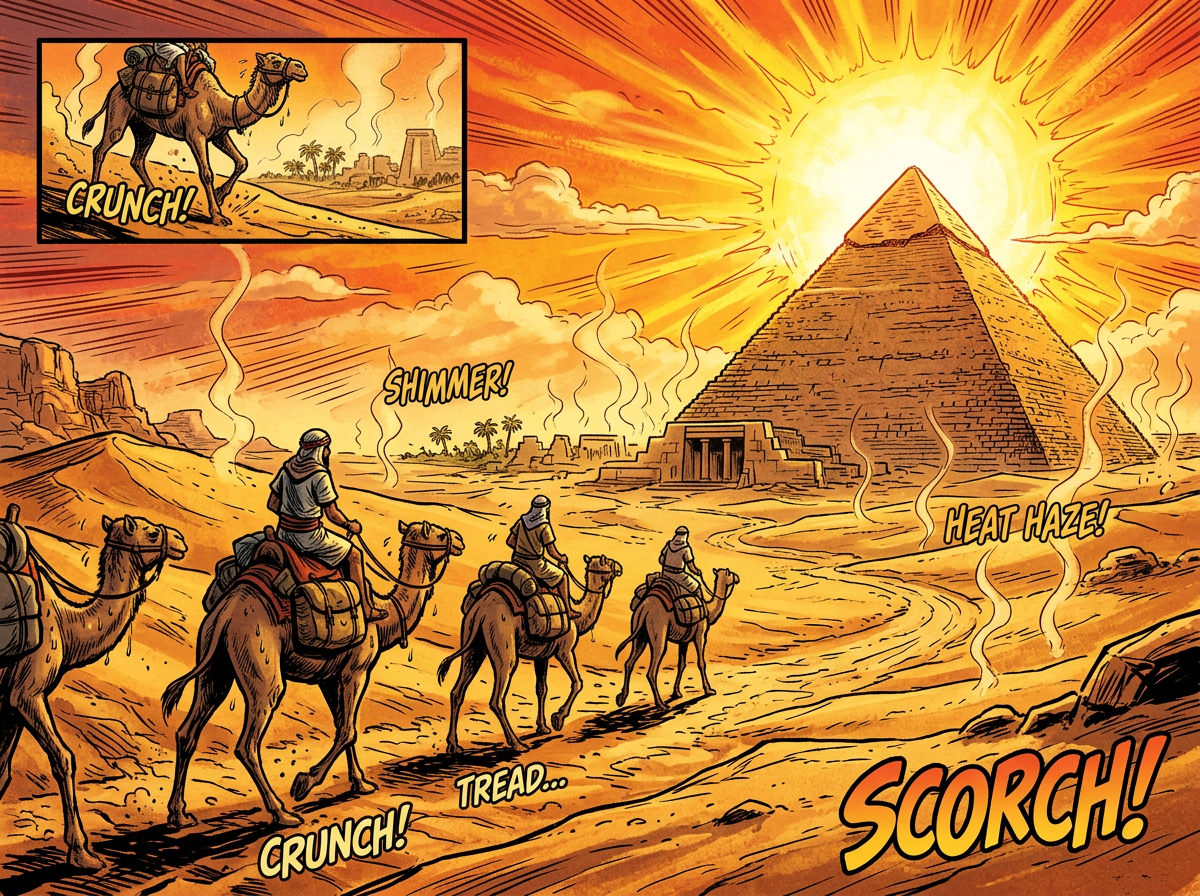
It was at least 95 degrees out in the desert of Arabia. My friends, Ryan, Andy, and I were going out into the desert to find the Pyramid of Doom. When we got there, we’d climb the pyramid and get to the great gold piece worth up to $5000. It sounds easy, but there were guards and automatic alarms. It would be very dangerous.
We had done two days of riding our camels, sweating, bleeding and getting sunburned. It was especially tough for Ryan. He had very sensitive skin. But we finally reached the Pyramid of Doom. All three of us were now at the foot of the pyramid.
“The first thing we must do,” said Andy, “is find the entrance.”
So we all split up in three directions and whoever found it would whistle three times. I found it, but I couldn’t whistle, so I just yelled.
“Well,” said Ryan, “We found the entrance, so let’s go inside.”
“Hold on,” I said. “Look at this rope lying here. Why go inside when we could climb?”
“No,” said Ryan. “It might be air conditioned inside.”
“Both of you be quiet,” said Andy. “Let’s just go inside and get the gold piece.”
So they all three went in. I had a pistol, Ryan had a whip, and Andy had a sword.
The first guard was easy to get by, and so was the second. But the second soldier was smarter. He knew what we were after. He quickly alarmed all systems. It was a pretty advanced pyramid. Brian went through a trap door, but me and Andy just had to leave them behind. We climbed three flights of stairs, but they trapped us. But there was a window right next to us. And I still had the rope we had found. We went out the window. I tied the rope to a rock at the top. Andy and I climbed up it fast. We were both scared, but we kept on higher and higher, until me and Andy had reached the top. And up there we met Ryan. He had escaped.
All the soldiers had either fallen or were afraid of heights. We got the piece and left for home. But it wasn’t over yet. Some soldiers were angry and chased after us. So our camels went faster. They threw grenades and shot their guns. One of them hit Andy’s camel in the back. When the camels finally gave up, we killed them so they wouldn’t suffer. And so we ran. But we all had our weapons too, so we hid behind a boulder and as soon as they went by, we ran after them. Then Andy used his whip on the camel’s head. Ryan sliced the camel’s legs off. And he told them to put their hands up. And we were all now safe.
The end.
Looking back, there is brilliance to the internal logic of a ten-year-old writer.
First, there is the magnificent convenience of the plot devices. Lost in the vast, unforgiving expanse of the Arabian desert? Don’t worry — someone left a climbing rope lying on the sand right outside the ancient structure. Need to signal your crew? If you can’t whistle, yelling works just fine.
Second, consider the priorities of the characters. We had spent two days sweating, bleeding, and enduring brutal sunburns (poor Ryan, cursed with sensitive skin in the middle of the Middle East). Yet, when presented with an ancient pyramid, Ryan’s primary hope is central air conditioning. It’s a completely rational request for a kid writing in a climate-controlled classroom.
Then there is the loadout. We didn’t bring canteens or extra rations. Instead, three ten-year-olds packed a pistol, a bullwhip, and a short sword — an arsenal shamelessly lifted from Indiana Jones and Sunday morning cartoons.
And finally, the sheer, dark escalation of the climax. A grenade hits a camel in the back. The camels “give up.” In a moment of surprisingly grim mercy, we put the animals out of their misery, only to immediately pull off a tactical ambush from behind a boulder involving whip strikes, leg-slicing combat moves, and a polite command to “put your hands up.”
We don’t write with that kind of uninhibited speed as adults. We worry about plot holes, realistic dialogue, character motivations, and whether a five-thousand-dollar gold piece justifies hiring a squad of grenade-tossing mercenaries. Ten-year-old me didn’t care about any of that. He just wanted to get to the top of the pyramid before the bell rang for recess.
There’s a lesson in that raw enthusiasm. Sometimes, as writers, we get so bogged down in refining the narrative that we forget the original spark that brought us to the page in the first place: the sheer joy of plunging our characters into ridiculous danger and figuring out a way to get them home safe.