Sal's site
Legendary alternative rocker Bob Mould bounded onto the Rose Bowl Tavern stage on September 21, 2024, to kick off his PYGMALION set with what looked like pure excitement—or perhaps raw, pent-up energy. For nearly an hour and a half, Mould and his electric guitar rarely let up, pausing only to offer fiery political reflections and tender personal memories.

Mould boasts a massive catalog to draw from, spanning his wild 1980s punk rock roots as the frontman of Hüsker Dü to the glossier, power-pop wallop of his 1990s band, Sugar. Yet the bulk of the 20-plus songs he delivered at the Rose Bowl came from his extensive solo work.
He opened the night with “The War” from 2014’s Beauty & Ruin. His take-no-prisoners performance also featured a string of beloved Hüsker Dü classics, including “Flip Your Wig,” “I Apologize,” “Celebrated Summer,” and “Something I Learned Today.” For Sugar fans, he delivered crowd-pleasing renditions of “Hoover Dam” and “If I Can’t Change Your Mind.”
After ripping through “Siberian Butterfly” from his 2020 album Blue Hearts, Mould paused to ask the room who had watched the recent presidential debate between Kamala Harris and Donald Trump. The crowd responded with a mix of groans, laughter, and cheers. One of the greatest joys of an intimate venue like the Rose Bowl is the easy dialogue between artist and audience. When a fan shouted to ask if Mould would play at a potential Kamala Harris inauguration, the crowd roared. Mould, who launched his career in Minneapolis, repeated the question before offering a smile.
“That’s up to Tim [Walz],” he said. “That’s not up to me. I don’t know. Of course, I’ll do anything for my country.”
Mould candidly described himself as “pretty liberal,” though noted he remains skeptical of “free money”—a mindset likely forged during his hardscrabble early days scraping together a living with Hüsker Dü. Above all, he voiced a desire for the nation’s political temperature to cool down.
“When November is over and things start to get back to normal,” Mould said, “I am all about hearing what the normal right has to say about things. It’s not like it has to be my way. There’s room for all of us. Just do not bring those crazy people.”
Exclaiming, “I just want things to go back to normal!” Mould launched into “Sinners and Their Repentances” from his seminal 1989 solo debut, Workbook.
Mould’s frenetic stage presence—astounding for a 63-year-old veteran who has been touring for over four decades—was utterly contagious. His hard-driving guitar work and razor-sharp vocals haven’t dulled a bit. On tracks like “Keep Believing” (from Silver Age) alongside “Daddy’s Favorite” and “Voices in My Head” (both from Patch the Sky), he deftly and frantically tackled lead and rhythm duties simultaneously.
Yet beneath his permanent punk-rock exterior beats the heart of a deeply sensitive, emotionally open songwriter. During “Hardly Getting Over It,” he sang the cutting line: “My parents they just wonder when they are both gonna die.” Shaking his head mournfully, he followed it with the gut-punch finish: “And what’ll I do when they die?”
Midway through the set, Mould reminisced about Hüsker Dü’s maiden 1981 tour, getting health insurance for the first time, touring Canada, and crashing on a friend’s back porch in San Francisco. The room erupted when he announced that he had married his husband a year and a half ago in San Francisco—at the very same spot where he once relied on food stamps.
“If you don’t cheer loud, my husband’s going to kill me,” Mould joked.
The tone turned reverent when Mould reflected on being 20 years old and seeing a flyer for “gay cancer” at Star Pharmacy in San Francisco, mourning the “great, wonderful people” lost during the 1980s AIDS epidemic.
“I bring it up as a cautionary tale because our time is limited, and we really need to take care of ourselves, believe in science, and just try to do the right thing,” Mould said. “I’m really grateful that I’m still here. I’m really grateful that you’re all here with me, together, tonight.”
He then segued into “Too Far Down” from Hüsker Dü’s Candy Apple Grey—a track highlighting his early struggles with clinical depression.
The night closed with “Makes No Sense at All,” one of Hüsker Dü’s most enduring anthems, complete with a soaring, singalong chorus. It served as a fitting end, perhaps doubling as Mould’s final commentary on the state of modern politics.
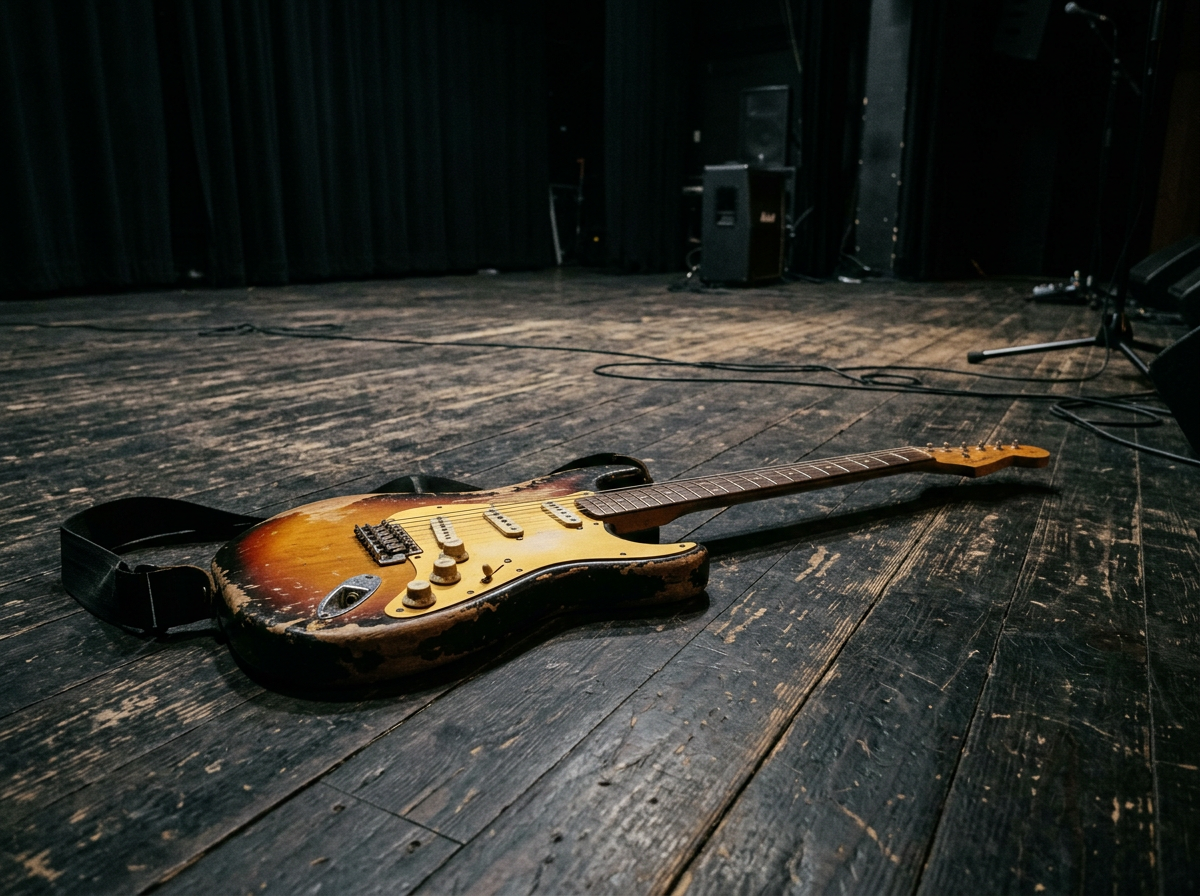
Stripped down to nothing but raw vocals and a roaring electric guitar, the solo setup was a thrill to experience. At first, the mind naturally expects—or even longs for—a backing bass and drums. But within minutes, those expectations vanish. The legendary wall-of-sound Mould has perfected over forty years fills every inch of the room, feeling like the most natural thing in the world.
Photo by Sal Nudo.