Sal's site
Decades after racing ten-speeds toward a 26-cent Snickers bar, an evening walk with my seventy-four-year-old father reveals how trails, knees, and childhood innocence shift with the passage of time.
In the summer of 1986, freedom cost exactly twenty-six cents.
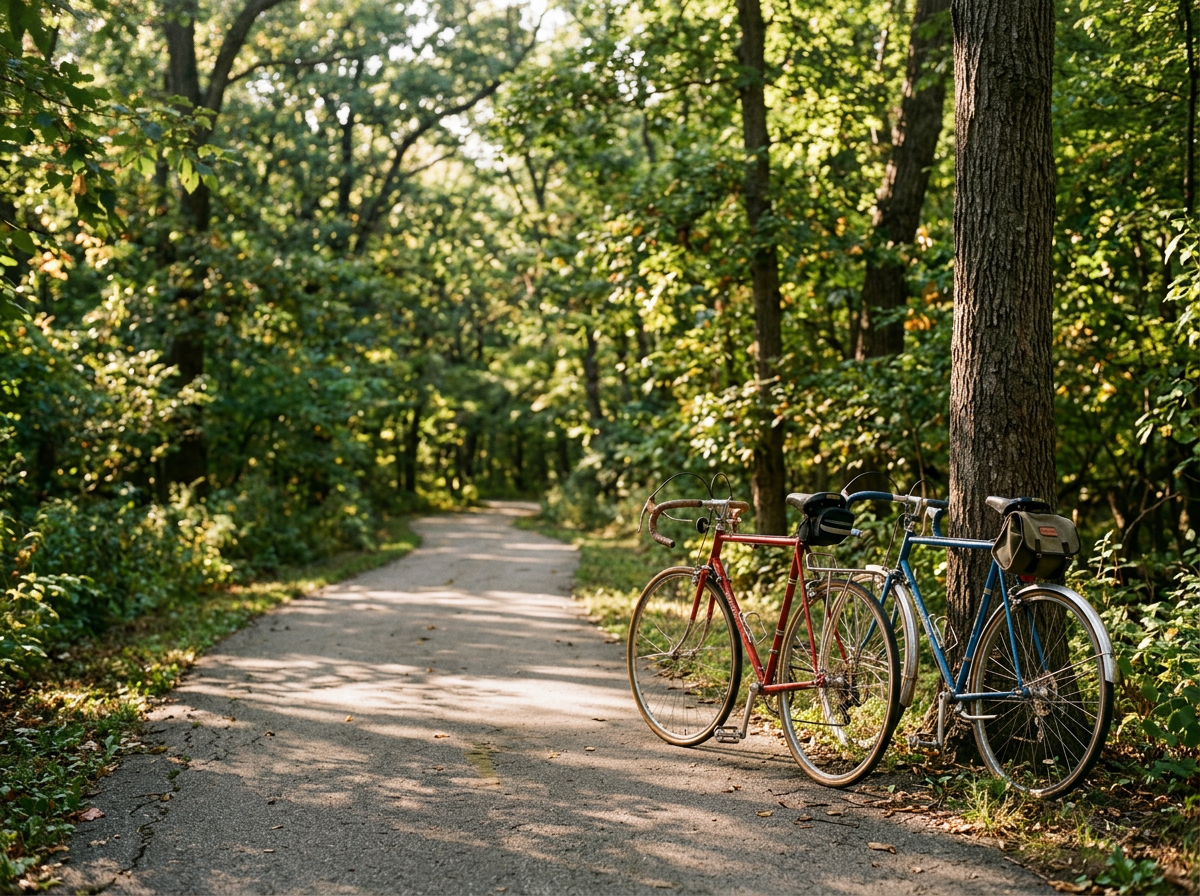
Back then, the neighborhood boys from Rolling Acres and I would hop onto our ten-speed bicycles and pedal hard toward what felt like the edge of civilization. Our route funneled into Roby Trail at Robeson Park, spilling onto the municipal sidewalks that led straight to the promised land: the corner Walgreens.
Once our bikes were chained to the rack, we’d march through the automatic sliding doors with the focus of seasoned commuters, lay our spare pocket change on the counter, and claim a Snickers bar. We never bought anything else. The candy bar was simply the trophy—proof that we had crossed town on our own two wheels and lived to tell about it.
Thirty-six years later, I returned to the trail on a radiant, early-evening walk. This time, there were no bicycles, no pocket change, and no childhood sprint. Instead, my companion was my seventy-four-year-old father, Alan.

Shadows on Duncan Road
We left our cars in the lot of a church off Duncan Road around six o’clock. The prairie sun was beginning its long, slow decline, casting warm golden slants across the 27.5-acre expanse of Robeson Park.
The park itself shares my exact vintage. Established in 1973—the year I was born—it was created to honor F.K. Robeson Sr., the founder of Champaign’s landmark department store. As a boy, this ground felt boundless, an untamed stretch of earth where the sky met the wild grass. Today, thirty-six years of suburban sprawl have hemmed it in. Subdivisions hug the borders, and mature trees cast wide canopies where spindly saplings once stood.
Yet what the park has surrendered in raw frontier, it has gained in grace. Near the trailhead, a limestone bench invites visitors to simply “Relax,” flanked by a memorial plaque honoring Kyle Robeson’s love of open spaces and three bronze dog statues so convincingly crafted you instinctively reach out to scratch behind their ears. Further along, another paved alcove features poetic inscriptions encircled by benches, where a woman sat intensely focused on a glowing tablet screen, waging a quiet, losing battle against modern technology.
As we fell into step, my attention lingered lower. The side of my left knee had been pulsing with a dull, unpredictable ache for weeks. Walking beside my father, who logs four miles daily with the steady, metronomic discipline of a retired marine, felt like a quiet fitness exam.
“I’m keeping it slower than usual for you,” Dad noted casually, glancing over with a slight smirk.
He was right, of course. For the first mile, my internal stakes weren’t about reaching the Walgreens; they were about whether my joints would hold up for the full three-mile out-and-back loop.

The Art of Steering
The trail gently undulates—hilly by central Illinois standards—crossing rustic timber footbridges over meandering creeks. Here, flanked by thick, untamed brush that remains remarkably clean and free of litter, the outside world briefly receded.
Then came the rustle of tires.
From behind us, a small voice piped up: “Excuse me.”
Before either of us could step aside, the front tire of a bicycle slammed hard into the back of my father’s right leg. Dad let out a sharp yell as the impact buckled him forward. The rider—a boy of perhaps six or seven—lost control, tipping over the handlebars and tumbling into the tall grass flanking the concrete.
For several seconds, the trail fell dead silent. The boy sat clutching his foot, rubbing a bruised toe through his sneaker. Dad stood upright, checking his calf, which bore a powdery white scuff mark from the rubber tread.
“Is everyone okay?” I asked.
Neither answered. The silence hung heavy in the evening air—a clash between youthful recklessness and aging vulnerability.
Then the boy looked up, wide-eyed, realizing the gravity of striking an adult stranger twice his size. “I’m sorry,” he whispered, his voice trembling.
The frustration on my father’s face instantly softened. He stepped forward, reached down, and gently patted the boy’s shoulder.
“It’s alright,” Dad said reassuringly. “Just be careful.”
Watching the boy pick up his bike, I recognized the moment for what it was: a fundamental childhood rite of passage. He wasn’t malicious; he had simply encountered the limits of his own steering. He had learned the terrifying, necessary truth that the throttle is easy, but navigation requires foresight—and that when you make a mistake, an apology and a steady adult hand can put the world back on its axis.
I looked at Dad, standing tall with a chalky tire tread on his leg, realizing how often fatherhood is less about lecturing and more about absorbing the blow with grace.
What Remains at the End
We resumed our trek, following the asphalt ribbon as it traced the socioeconomic layers of west Champaign.
Roby Trail operates as a great equalizer. It begins among the manicured lawns and stately brick homes near the park’s entrance, snakes past middle-class ranch houses, and eventually winds alongside older, weathered properties before reaching its southern terminus.
“It’s good that everyone along this path has access to it,” Dad observed as we turned back.
He was right. In an increasingly divided landscape, the path is shared ground—where retirees get their daily miles, neighbors walk their dogs, and neighborhood kids practice the precarious art of balance.
Heading back toward Duncan Road, the trail felt undeniably different than it did in 1986. It was smaller, more crowded, and less mystical than the endless open expanse etched into my eleven-year-old memory. The sweet rush of a twenty-six-cent Snickers bar was a relic of an unrecoverable era.
Yet as we reached our cars under the fading twilight, my knee was holding firm, and Dad was walking tall despite the bruise forming on his calf. The destination had changed, but the trail had offered something better than a childhood sugar rush: three miles of uninterrupted conversation, a quiet reminder of forgiveness, and the timeless gift of walking alongside my father.

Pictures by Sal Nudo